
What Is the 5D Profile Assessment?
An Aptitude Assessment That Integrates Personality Traits, Cognitive Traits, Emotional Traits, Behavioral Traits, and Work Values
Today’s business environment is defined by rapid change and complexity,
often described as the
VUCA era (Wikipedia).
In this environment, conventional aptitude assessments have tended to focus too heavily on personality alone,
making it difficult to fully understand important factors such as Behavioral Traits, Work Values, and Cognitive Traits,
and therefore difficult to accurately identify a person's strengths.
The 5D Profile Assessment comprehensively assesses
five dimensions: Personality Traits, Emotional Traits, Cognitive Traits, Behavioral Traits, and Work Values,
and clarifies the internal structure of each person's strengths and aptitudes.
The "D" stands for dimension.
It supports optimal placement, education and training, promotion of the right people,
improvement of
human relationships (Wikipedia),
and team building through scientific data.
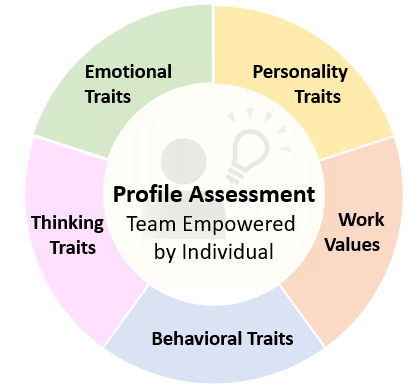
The 5D Profile Assessment is an innovative profile tool designed to respond to fast-changing business environments and increasingly advanced talent needs.
In psychology, a profile is a "portrait of a person" created by analyzing behavior, thinking, emotions, values, and related characteristics to summarize that person’s tendencies and traits.
Profiles are widely used in areas such as talent hiring, right-person-right-role placement, improving relationships, special behavior prediction (such as tendency to cause problems or commit crimes), coaching, and counseling.
In this 5D Profile Assessment, the trait assessment domains of Personality Traits, Work Values, Behavioral Traits, Cognitive Traits, and Emotional Traits are assessed across five dimensions.
By using this tool, organizations can achieve more essential talent management, place people where their strengths and aptitudes can be best used, improve talent management,
enable more effective communication within teams, support organizational development with psychological safety,
and as a result maximize both individual and team productivity and contribution.
In addition, incorporating a profile tool into aptitude assessment is a method that helps companies and organizations make more accurate and optimal assessment decisions
in securing the talent they need, hiring, and talent management.
Specific benefits include the following.
- Detailed data analysis: A profile tool provides detailed analysis of the skills, personality, and psychological traits of desired talent and candidates, offering information that cannot be obtained through behavioral observation, interviews, or documents alone.
- Prevention of hiring mismatches: By using aptitude assessment, companies can identify talent that fits their corporate culture and job roles, reducing mismatches after hiring.
- Greater efficiency in promotion, placement, and other talent processes: A profiling tool improves the efficiency of these processes and reduces time and cost.
- Data-based decision-making: By making hiring and placement decisions based on objective data, companies can achieve fair and transparent talent management.
Why is it necessary to share this with teams and management as well?
First, when leaders and managers understand the traits and strengths of each member, they can place people in the most appropriate roles. This allows members to perform at their highest productivity, creates an environment where they can work with confidence, and improves the overall efficiency of the organization. Also, by understanding the best communication methods for each member's traits, communication within the team becomes smoother. For example, for members with intuitive thinking, an approach that shares vision and ideas can be more effective than detailed data or analysis. In addition, when management understands each member’s traits, it becomes easier to design individual role assignments and career paths.
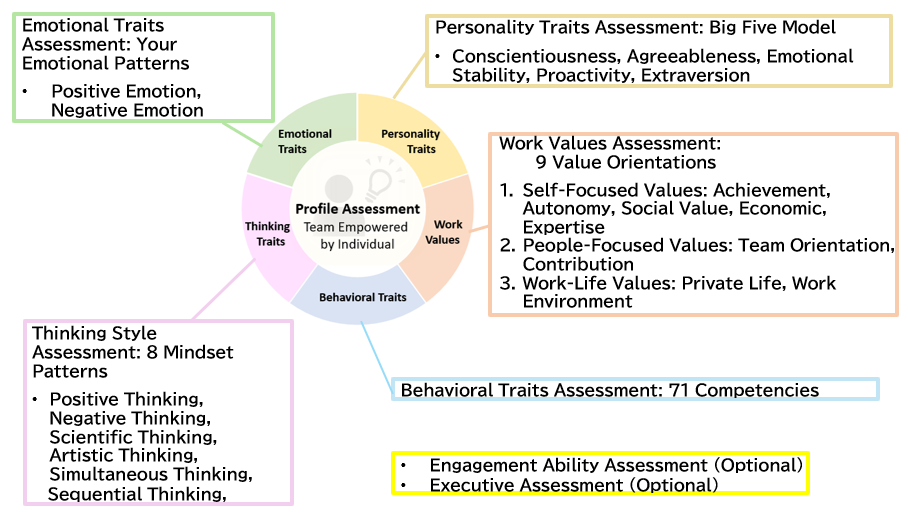
The Five Assessment Dimensions and Deliverables | PDF Reports for the Individual, Supervisor, and Team
The five dimensions assessed are Personality Traits, Emotional Traits, Cognitive Traits, Work Values, and Behavioral Traits.
By assessing these traits comprehensively, it becomes possible to accurately understand the characteristics and strengths of each member and place them in the most suitable roles and work.
In addition, understanding these traits helps improve communication within the team and increase member motivation.
By assessing the five dimensions comprehensively, organizations can improve overall efficiency and productivity while also increasing member satisfaction.
Of course, this also helps supervisors manage and communicate with members more smoothly.
The following deliverables are available. The PDF deliverables are prepared for the individual, supervisor, and team.
- Personality Traits Assessment: Personality assessment results based on the Big Five method
- Work Values Assessment: Work values assessment results that identify what drives motivation
- Behavioral Traits Assessment: Results showing manifest strengths, Latent Abilities, and related traits
- Cognitive Traits Assessment: Results on how a person uses thinking
- Emotional Traits Assessment: Results on how a person uses emotions
- Engagement Ability Assessment: Advice for understanding a person’s attitude toward work and helping develop it further
- Recommended Training Assessment: A proposal for the training program most strongly recommended based on the aptitude assessment
- Conceptual Ability Assessment: Results of the abstraction ability assessment
- Belief and Behavioral Axis Assessment: Analyzes variation in responses and consistency in words and actions as part of the Response Attitude assessment, displayed in three levels
- General Personality Impression Based on Personality Assessment: Presents a simple one-phrase impression of the person’s personality
- Leadership Assessment: Leadership assessment results for leaders
- Advice for Members: Advice for building good communication based on understanding colleagues’ personalities and traits
- Advice for Supervisors: Advice on subordinates’ strengths, traits, career development ability, management, and motivation points
Reference link: Wikipedia: Big Five (Psychology)
The Personality Traits in the 5D Profile Assessment are based on Big Five theory.
However, the Big Five is a model developed for academic research and was not originally designed for business use.
Therefore, in the 5D Profile Assessment, Personality Traits have been reconstructed into a business-focused model that can be practically assessed in real workplace settings.
Seven Benefits of the 5D Profile Assessment | Scientific Support for Hiring, Placement, Development, and 1-on-1 Meetings
1. Right-Person-Right-Role Placement
It becomes possible to place each person in the most suitable work and role based on individual traits and strengths. Members themselves can also feel satisfied with the placement. The main objective is to objectively provide an environment in which members can perform at their highest potential. As a result, the overall efficiency and productivity of the organization improve, and member satisfaction also increases.
2. Optimizing Communication Within the Team
It proposes the most suitable and effective ways of communicating according to each person's traits. It deepens mutual understanding within the team and strengthens cooperation. It also suggests how to communicate effectively with supervisors. By understanding individual approaches, misunderstandings and friction can be reduced. It helps promote better communication across the entire organization.
3. Management That Makes Use of Each Member’s Traits
Supervisors can use each member’s personality and strengths when assigning duties and roles. As a result, they can understand each person’s sources of motivation, making communication with members easier. This goes beyond improving only the motivation of individual members; it also raises the motivation of the organization being managed and enables optimal management of talent across the organization.
4. Building Strong Teams
By clarifying each member’s traits, mutual understanding deepens, and both teamwork and project progress become smoother. As a result, the team becomes stronger and can achieve even challenging goals. Strong teams require quality of relationships, quality of thinking, and quality of action. When good communication and psychological safety are added on a daily basis, team goals can be achieved.
5. Using Diversity Effectively (Diversity & Inclusion)
When members understand each other’s personalities and work values and accept and respond to diversity, the team can increase creativity and evolve into a group that responds flexibly to a rapidly changing business environment.
6. Supporting Individual Growth and Career Development
It becomes possible to consider feedback and career development based on understanding each member’s personality and strengths. Management can clearly communicate expectations regarding duties and roles to members. It also supports members’ career development and enables long-term support.
7. Supporting Data-Driven Decision-Making
It supports objective decision-making. In particular, ① hiring decisions, ② promotion decisions for management positions, ③ organizational design decisions, ④ personnel transfer decisions, ⑤ gap analysis compared with high performers, as well as career development and education and training, ⑥ harassment prevention, and ⑦ decisions on who should take leadership roles in transformation and innovation become more scientific and effective.
Data-driven means a method of making talent management decisions based on assessment data rather than relying only on intuition and experience.
It is important that executives, managers, HR, and the individual all use the same assessment data and make the best decisions from their own positions.
At a time when values and behavior are becoming more diverse, decisions based only on intuition and experience can no longer capture the internal structure of the individual well enough,
making it harder to reach optimal decisions.
That is why future talent management requires the ability to evaluate people not by instinct alone, but through objective judgment based on data.
The Psychological Mechanism Behind Human Action | Assessment Theory Based on Behavioral Psychology and Depth Psychology
Human action emerges through the process of "stimulus" → "cognitive appraisal" → "behavioral decision" → "behavioral execution". First, "stimulus" includes both external and internal stimuli. External stimuli are received through the five senses, while internal stimuli arise through emotions, thoughts, and bodily sensations. People then assign meaning to those stimuli in their own way and consider how to respond based on their emotions and values. This is "cognitive appraisal".
 After that, considering personality, values and Work Values, emotions, habits, and social influence, the process reaches "behavioral decision".
Finally, based on that decision, the person moves to "behavioral execution", where actual action is taken.
The area where behavior can be observed is the first layer, the more visible domain. In this layer, Behavioral Traits can be assessed. Many aptitude assessments focus on this domain.
After that, considering personality, values and Work Values, emotions, habits, and social influence, the process reaches "behavioral decision".
Finally, based on that decision, the person moves to "behavioral execution", where actual action is taken.
The area where behavior can be observed is the first layer, the more visible domain. In this layer, Behavioral Traits can be assessed. Many aptitude assessments focus on this domain.
In particular, in the less visible domain of depth psychology and cognitive appraisal, the third layer of past experiences, values, and Work Values, as well as the fourth layer of Cognitive Traits such as beliefs, aspirations, determination, and convictions, have a deep influence, and these determine what kind of behavior will result. By comprehensively analyzing emotions, thinking, values, personality, and behavior across five dimensions based on this mechanism, it becomes possible to conduct a profile assessment grounded in behavioral psychology.
In the fields of Behavioral Traits assessment and competency assessment, accurate assessment has traditionally required specialized training. In particular, one reason the competency model did not spread widely in Japan has been pointed out as the lack of a thinking-based understanding of "why can that person do that?" Without understanding this "why," simply imitating successful behavior has limited effect, and this is where a major difference exists between Japan and Western countries.
By using knowledge from behavioral psychology, depth psychology, and cognitive science, it has become possible to identify Behavioral Traits and competency models based on elements such as Personality Traits, Cognitive Traits, Emotional Traits, and Work Values. This assessment can discover not only strengths that individuals are already aware of, but also potential strengths they do not yet recognize. These latent strengths may be activated as abilities through certain triggers, and this is where the value of talent development and education and training can be created.
The 5D Profile Assessment is an innovative method that can assess both recognized and unrecognized Behavioral Traits by comprehensively analyzing five dimensions. This assessment approach was developed through many years of research and is an important tool for a new era that seeks to understand diversity and accept diversity.
The 5D Profile Assessment system is an aptitude assessment tool built on the following five-dimensional trait master framework.
- 1. Five Personality Traits: Conscientiousness, Agreeableness, Emotional Stability, Proactivity, Extraversion
- 2. Three Emotional Traits: Positive Emotions, Negative Emotions, Neutral Emotions
- 3. Six Cognitive Traits: Positive Thinking, Negative Thinking, Scientific Thinking, Artistic Thinking, Simultaneous Thinking, Sequential Thinking, Plus Thinking, Minus Thinking
- 4. Nine Work Values: Achievement Orientation, Autonomy Orientation, Social Value Orientation, Economic Orientation, Expertise Orientation, Team Orientation, Contribution Orientation, Work Environment Orientation, Private Life Orientation
- 5. 71 Behavioral Traits: There are 71 in total. Representative examples include Creativity, problem-solving, interpersonal relationships, and management.
Frequently Asked Questions (FAQ)
- Q. What kinds of companies is this suitable for?
- A. It is effective for companies facing issues such as not fully utilizing team strength, being unable to reduce turnover, declining engagement, poor human relationships, difficulty managing older subordinates, failure to make use of diversity, and not making use of individual strengths.
- Q. What types of reports are available?
- A. We provide PDF reports for the individual, supervisor, and team. The supervisor version focuses on management, and the team version focuses on improving communication.
- Q. How long does the assessment take?
- A. As a guide: Managers: about 40 minutes (80-minute limit) / General employees: about 30 minutes (60-minute limit).
- Q. How is the assessment conducted?
- A. It is conducted online. A PC is recommended, though mobile devices are also supported.
Aptitude Assessment Service
Strategic Human Capital Consultant’s aptitude assessment service uses psychology × statistics × behavioral analysis to visualize personality, thinking, emotions, values, and behavior from multiple angles.
The results are provided as PDF reports and can be used for placement optimization, development planning, 1-on-1 meetings, and team strengthening.
It supports data-based management and helps improve organizational productivity and engagement.
"Organizations become stronger when people make the most of each other’s individuality."