
1. What Is Talent Management? | Why Organizations Need It Now
Talent management refers to the management strategy and practical system used to make visible the strengths, potential, fit, and values of the talent an organization possesses, and then connect that insight to optimal placement, development, evaluation, compensation, and career development.
For organizations, the core idea of talent management is to view critical talent not as a simple cost, but as an investment target that should generate long-term results. For that reason, the concept is sometimes expressed in a way that emphasizes talent as an asset rather than just labor.
In recent years, the business environment described as VUCA, meaning volatility, uncertainty, complexity, and ambiguity, has become increasingly important. As the cycles of market demand and technological innovation accelerate, organizations need the ability to respond quickly to change and a diverse set of skills for increasingly complex work in order to survive and continue growing. In addition, to create innovation for an uncertain future, conventional ways of working alone are no longer enough. New ideas and projects are more likely to emerge when diverse talent exists within the organization.
Talent management becomes a powerful way for organizations to respond quickly and flexibly to change by identifying not only the visible capabilities but also the latent potential of diverse talent at an early stage, and by giving people the right roles and opportunities.
There are also major differences compared with conventional human resource management.
First, talent management does not treat labor cost as a mere expense. It treats people as an investment that increases corporate value and justifies proactive resource allocation to development and placement.
Second, decisions on evaluation and placement do not rely only on a manager’s experience or subjective judgment. They also use objective data such as personality tests, aptitude assessments, and behavioral trait data,
making more scientific and accurate matching possible. In addition, instead of relying on uniform training programs or seniority-based career steps, organizations can design career development and skill-building programs
tailored to each employee’s strengths, expertise, and aspirations, thereby increasing motivation and productivity.
Finally, by building systems for optimal placement and skill development, the organization can foster a culture that grows on the assumption of change,
creating a stronger structure for responding to the VUCA era.
2. The Benefits of Talent Management
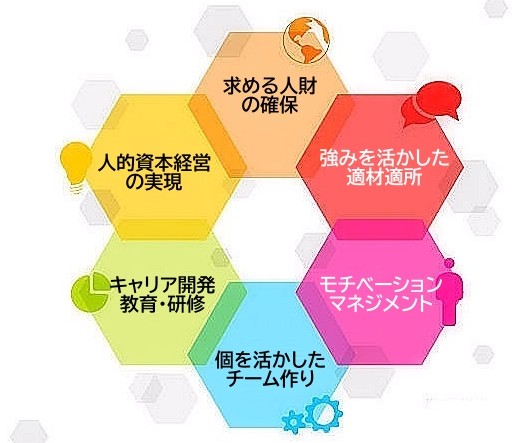
When talent management is introduced, organizations can create a structure that makes it easier to achieve continuous growth and innovation, even in a rapidly changing business environment,
while drawing out the full potential of each employee.
It can increase productivity and cohesion across the organization as a whole and, as a result, has strong potential to significantly strengthen corporate competitiveness.
Below is a structured summary of the main benefits.
For a broader perspective on the philosophy behind talent management and an alternative viewpoint, see the column Talent Management Is Human Resource Management Version 3 for a more detailed explanation.
- Promotes Employee Growth and Increases Motivation In talent management,
the focus is on carefully understanding the traits each employee brings, including strengths and values, and assigning work and roles that align with them.
When employees are placed in an environment where they can use their strengths, they are more likely to act proactively rather than simply doing what they are told.
When individual growth becomes connected to organizational goals in this way, motivation toward work naturally rises, and employee engagement can also be expected to improve.
- Activates Innovation When talent management makes diverse personalities and specialized skills visible,
it becomes easier to form teams with the right mix of people.
For example, bringing together members with achievements in different fields increases the likelihood that new ideas and perspectives will emerge,
creating an environment where unexpected synergies can develop.
When this kind of team design becomes routine, an innovation mindset can take root across the organization, increasing the likelihood that new projects and innovative ideas will emerge spontaneously,
even in a rapidly changing business environment.
- Reduces Management Risk In any organization, there is always a risk that critical projects will stall if a key person suddenly resigns or is transferred.
Talent management addresses this by regularly making employees’ skills and career orientation visible,
and by continuously developing and positioning future successors and highly specialized talent.
This helps prevent excessive concentration of work in a specific individual and makes it easier to secure management stability and continuity.
- Strengthens Organizational Competitiveness In the VUCA era, the business environment changes constantly, and common assumptions or past success patterns often stop working.
To respond to this environment, organizations must continue to use their talent flexibly and strategically.
By improving the accuracy of development planning and placement decisions through talent management, organizations can more easily maintain and strengthen competitiveness over the long term.
For example, it can support the creation of an organization capable of adapting to change through new technology adoption or global business expansion.
3. Why Individual Employee Assessment Matters
At this point, it should be clear that individual employee assessment or testing is important for introducing and operating talent management.
That is because it is an essential means for organizations to make the best use of diverse talent and improve overall organizational performance.
Below are the main reasons.
- You Can Objectively Understand Each Employee’s Strengths and Traits
- It Reduces Mismatches in Placement and Development
- It Supports Individually Optimized Career Development
- It Improves Communication Within the Organization
When people understand their own and others’ patterns of thinking and behavioral tendencies through assessment, it becomes easier to recognize and accept differences. In practice, many conflicts and communication gaps within teams arise from misunderstanding the other person’s personality or behavioral tendencies. Sharing assessment results deepens mutual understanding and promotes smoother communication.
- It Reduces Management Risk and Supports Long-Term Organizational Growth
Assessment is a means of objectively measuring personality and behavioral traits.
Rather than relying only on the impressions of supervisors or colleagues, it makes it possible to understand the areas each employee excels in and their preferred way of working based on scientific and statistical evidence.
Having this kind of objective data makes it easier to make sound decisions about placement and career development.
When a mismatch arises between the person and the work, what kind of behavior is likely to follow? In most cases, risks such as lower motivation, turnover, and reduced organizational productivity emerge.
By using the data obtained through assessment, organizations can more easily consider work assignments and positions that match an employee’s personality, orientation, and skill set,
which in turn can reduce turnover and improve productivity across the company.
When an employee’s strengths and issues are made clear, it becomes easier to design development programs suited to each individual.
For example, an employee identified as a leadership candidate can be given training focused on management skill development.
This makes individualized career support possible, while also strengthening the foundation for raising the employee’s own willingness to grow and enabling the organization to develop talent in a planned way.
To reduce the risk created by the sudden departure of key people, organizations need a structure in which multiple people are capable of taking on important roles.
If the strengths and potential of each employee are understood through aptitude assessment, it becomes easier to develop successors systematically and to identify future leadership candidates and experts in specialized fields at an early stage.
These efforts can support the organization’s sustainable growth over time.
Assessment is an effective tool for objectively understanding each employee’s strengths and traits and using that understanding for appropriate placement, development, and team building. It plays an increasingly important role for organizations seeking to evaluate person-job fit and raise both organizational productivity and employee motivation. For companies that want to respond quickly to change and continue growing over the long term, using assessment is no longer optional. It is essential.
4. Current Types of Assessment, Their Features, and Their Challenges
There are many different types of assessment in use today, and each has its own characteristics and challenges.
These include personality assessments, cognitive ability tests, competency evaluations, 360-degree feedback, and integrated assessments using AI. It is important for each organization to choose a method that fits its purpose, scale, and culture.
At the same time, every assessment result should be treated as only one part of the data. When the organization puts the right use methods and feedback structure in place, the results can contribute to employee growth and improved organizational performance.
When introduced and operated appropriately, these systems can become highly beneficial for both people and the organization.
Below is a summary of the main types of assessment commonly used in companies and organizations today, along with their characteristics and the challenges currently observed.
1. Personality Assessments
■ Features: Representative methods include the Big Five, MBTI, and DISC. These tools measure personality tendencies and behavioral traits from multiple angles, and are often used for team building, placement, and individual career development.
Many of them can be completed in a relatively short time, making them easy to introduce.
■ Challenges: Variation in measurement accuracy and reliability
Results can vary significantly depending on question wording and the respondent’s answering attitude.
It is important to confirm whether the assessment is grounded in sound psychological theory.
■ Interpretation often becomes subjective: How the results are used depends heavily on the understanding of the person handling them, so expert guidance and a proper feedback system are important.
2. Aptitude and Ability Tests
■ Features: These include cognitive ability tests, such as verbal, numerical, and logical reasoning, as well as general knowledge tests.
Because online testing systems are now widespread, these tools can be administered easily to large numbers of people and across repeated cycles.
They are useful for grasping the basic capabilities needed to perform work and are often used in new graduate hiring and general staff recruitment.
■ Challenges: Ability tests alone cannot capture the full range of human capability. Abilities that are difficult to quantify, such as creativity and communication skill, are hard to measure, which makes comprehensive evaluation difficult.
■ They may disadvantage certain respondents: Age, cultural background, and learning environment can create advantages or disadvantages.
To ensure fairness, they should be combined with other evaluation methods.
3. Competency Evaluations (Behavioral Trait Evaluations)
■ Features: These assessments are designed to make visible the behavioral traits, or competencies, that produce strong results in a given organization or role.
Respondents answer questions or describe behavior examples, and the assessment evaluates the extent to which they possess those competencies.
These tools can be customized to suit the organization’s culture or the role, and they are relatively easy to connect to actual business performance.
■ Challenges: Design and implementation require time and cost. Because the process of organizing company-specific behavioral traits and setting evaluation criteria is complex, ongoing operation after introduction also requires effort.
Maintaining objectivity requires expertise: Without expert supervision and statistical support, the criteria can easily become arbitrary.
■ Regular review is essential: Because required behavioral traits change with shifts in strategy and market conditions, ongoing updates are necessary.
4. 360-Degree Feedback
■ Features: This is a system in which evaluations are collected not only from supervisors, but also from peers, subordinates, customers, and other stakeholders.
Because it captures an individual’s behavior and skill from multiple viewpoints, it can help close the gap between self-evaluation and others’ evaluation, while making improvement points easier to identify.
It is also considered useful for activating communication and promoting mutual understanding across the organization.
■ Challenges: Bias and human relationships affect the evaluation. The quality of the results can be distorted by the relationships between evaluators and by likes or dislikes.
■ Follow-up after feedback is essential: Simply handing over the feedback often leaves unclear what behavioral change should happen next.
Unless goal setting and coaching are provided together with the feedback, the process easily becomes formalistic.
5. Integrated Web-Based Assessments, Including AI-Based Methods
■ Features: More organizations are now using integrated approaches that combine personality assessment, cognitive testing, video interviews, and AI-based behavioral analysis.
Systems have also emerged in which AI analyzes large volumes of assessment data to evaluate skills, orientations, and behavioral tendencies in an integrated way.
These methods are strong in speed and scalability, and they are attractive because they can be implemented online with relative ease.
■ Challenges: Data reliability and algorithm transparency: The process by which AI produces results can become a black box, making it harder for both organizations and respondents to trust the outcome.
■ Personal information and privacy protection: Because these systems handle multi-dimensional data, appropriate security measures and clear data-handling rules are essential.
■ Implementation cost and the need for specialized talent: To make full use of new technologies such as AI, organizations need people who understand them, which requires hiring or developing such expertise.
Overall Challenges and Future Outlook
- Lack of skill in interpreting and using results: Assessment results are only information. What matters is how they are connected to placement, development, and evaluation. Appropriate feedback and HR action are indispensable.
- Implementation cost and ongoing operational burden: Introducing assessment tools and systems costs money, and maintaining regular updates and validation also requires organizational support.
- A crowded market of tools and the difficulty of standardization: Many assessment tools exist, and each organization has different purposes and methods. Because standardization has not progressed, comparison takes time.
- Burden on individuals and psychological resistance: When people are asked to take multi-dimensional assessments too often, they may feel pressure or develop resistance.
- That is why the right frequency and clear explanation of the benefit to the respondent are important.
Support for Designing and Implementing Talent Management
Our consulting service, Support for Designing and Implementing Talent Management, draws on extensive experience in introducing talent management systems and offers a method for implementation that maintains both a management perspective and an HR perspective across the full picture. By applying psychological and statistical methods, we can improve the precision and reliability of the data.
Related Pages
- ▶ Talent Management Is Human Resource Management Version 3
- ▶ Why Talent Management Fails When Organizations Do Not Understand People’s Internal Structure
- ▶ Detailed Explanation of the 5D Profile Assessment
- ▶ Detailed Explanation of the Executive Profile Assessment
- ▶ Detailed Explanation of the Organizational Assessment
- ▶ Column Index