
1. What Is Psychological Safety? | What Kind of Organization Enables People to Speak Up and Take On Challenges with Confidence?
The aim is to create an environment where anyone can freely express their opinions and ideas, and can take on challenges with confidence.
Organizations, like society itself, are expected to keep growing over time.
To build an organization that can adapt to changing times, the first step is to understand how organizations grow, and then improve psychological safety as part of moving toward an organizational model suited to the new era. However, if large-scale change is imposed too suddenly, teams and organizations may become exhausted or dissatisfied. That is why a step-by-step approach toward the desired organizational state is important. First, the organization’s growth model needs to be properly understood. Next, the goal is to create an environment where people can exchange opinions freely and actively. Finally, the focus should be placed on securing psychological safety. Both open exchange of views and psychological safety are essential for healthy and effective team management. Psychological safety emphasizes “an environment where people can take on challenges with confidence,” while open exchange emphasizes “free and active communication.” By balancing these two elements, teams can build trust and achieve a higher level of creativity and innovation. For those concerned with organizations and HR, building an organization that fits the demands of the times is becoming increasingly important. Through a phased approach, the goal is to build an organization that is both sustainable and resilient.
Open and active “free exchange of opinions” means:
Open and active “free exchange of opinions” means:
- Active interaction: Ideas and opinions move freely, encouraging creative thinking.
- Flexibility: People are encouraged to think and act flexibly rather than being bound by formality.
- Sociability: Interaction among members is lively, helping build warm and constructive relationships.
Psychological safety means:
- A sense of security: Trust that one will not be rejected or punished for expressing an opinion.
- A sense of trust: A shared attitude that mistakes are treated as opportunities to learn rather than reasons to blame.
- Healthy communication: A culture where concerns, questions, consultations, and proposals can be shared freely.
2. Steps to Secure Psychological Safety
- Understand the organization’s growth model: Organizations also grow through stages. In particular, the four stages of the Tuckman model are useful here, and they are also consistent with lifecycle models and Greiner’s model. Forming ➡ Storming ➡ Norming ➡ Performing ➡ Adjourning
- Create an environment where open exchange is possible: During the Forming stage, the leader shares the organization’s purpose, reason for existence, and vision. The leader also establishes ground rules for the team. Because shared language is an important tool, the leader must define and present it clearly.
- Create opportunities for open exchange: To accept and value diversity, it is effective to actively introduce discussion formats such as the “Exchange Chair,” allowing people to experience that agreement and opposition can still exist within one team.
- Secure psychological safety: The Storming stage is usually experienced to some degree. However, how the team is handled in the Forming stage largely determines whether that stage can be navigated smoothly. The key initiatives at this stage are outlined below.
3. Key Initiatives for Achieving Psychological Safety
- Clarify the role of leadership: The leader should openly express opinions and show a willingness to accept feedback. This makes it easier for team members to speak up with confidence.
- Promote open communication: By not interrupting and by listening carefully and respectfully, leaders help members feel that their views are valued. Regular opportunities for feedback and constructive exchange are important.
- Create a culture that treats failure as a learning opportunity: Share failures within the team and analyze their causes to prevent repetition. A real failure is failing to learn from a failure. If learning has occurred, people should be encouraged to apply it next time.
- Respect diversity and inclusion: Build the awareness that it is natural for members to hold different perspectives and backgrounds, and actively embrace diversity. Organizations that practice the “Exchange Chair” have been able to recognize unconscious bias and shift their perspective.
- Set clear roles and expectations: Reconfirm the purpose and vision of the organization or team, and make sure every member truly understands them. At the same time, clarify each person’s role and responsibility so that they can work with confidence.
- Provide education and training on psychological safety: Hold workshops within the team to teach both the importance of the “why” behind psychological safety and the practical “how” for making it real. Actual communication methods matter greatly.
- Conduct regular evaluation and feedback: Monitor regularly how members experience psychological safety and understand the current state. Based on that, design and implement concrete improvement measures and continue to improve the environment.
- Embed an environment that accepts diversity: In regular team meetings and discussions, create opportunities for everyone to speak.
4. Five Effects and Benefits Psychological Safety Brings to Teams
When psychological safety is secured, the conditions that support team success become stronger, and the organization as a whole can gain the following benefits.
- Higher employee satisfaction, which can lead to lower turnover.
- Higher engagement with the team and organization, which can accelerate referral hiring as an effective way to attract strong talent through employees’ networks.
- More active exchange of ideas and opinions, which can lead to stronger performance.
- Better collaboration across departments, making work and coordination run more smoothly.
- A stronger sense of unity across the organization, encouraging everyone to take a more active role in solving organizational issues.
In this way, psychological safety brings major benefits to both the company and the team. It also makes work easier for members and can improve productivity, creating positive effects for both the company and its employees.
5. The Original Purpose of Aiming for Psychological Safety
The original purpose of introducing psychological safety is to achieve high team productivity. Psychological safety itself is a means to that end. In the short term, it may become an important goal, but the true purpose is team productivity. Ultimately, even that may serve a larger purpose. That larger purpose may be the continued economic growth of the company or business. Here, however, the focus is on its original purpose rather than its ultimate one. The true purpose of psychological safety is to create an environment where members can express themselves with confidence, leading to many positive effects such as more active communication, stronger innovation, better team performance, growth for both individuals and the organization, and stronger engagement. Through these effects, sustainable growth and success can be achieved for both the organization and the business as a whole.
Establishing psychological safety is not merely about improving the atmosphere of the workplace. It is a critical factor in strengthening organizational competitiveness. Leadership and continuous effort are essential, but those efforts can reliably contribute to organizational development. In today’s VUCA era, it is often said that past formulas such as “If we do this, it will work” or “This will definitely sell” no longer hold true. In fact, past success itself can get in the way of future success.
Against this backdrop, a shared challenge for companies and businesses is the ability to engage in “creative and innovative” efforts. In particular, it is often said that only three kinds of people are capable of driving real transformation: the young, the outsiders, and the so-called fools. The young refers to today’s Gen Z talent. Outsiders refers to mid-career hires and people who move across functions inside the company. The so-called fools are not literally foolish. They are people whose values differ sharply from the mainstream, such that others may say, “I can’t follow that person’s way of thinking.” Leaders themselves may not be the ones who create transformation, but they can lead it and support it. That is why leadership remains extremely important. What is required is the ability to bring these kinds of people together and help make change happen.
Bringing such people together to drive transformation, and intentionally promoting diverse talent so that entirely new ideas can emerge and creativity can grow, is one of the central challenges companies and businesses must address. We are now in an era where diversity can neither be denied nor rejected. Many leaders themselves have never previously faced this kind of external change. To avoid falling behind in this effort, timely judgment is essential.
For another perspective on psychological safety from the viewpoint of talent management and organizational design, please also see this column, which explains the relationship between organizations and talent from a different angle .
6. The Importance of the Soft Approach
Organizations are made up of groups of people, and those people are selected to realize specific purposes and values. To achieve those purposes, organizations need to build effective teams through appropriate hiring, promotion, transfers, and advancement. Concretely, it becomes essential to understand how the individual traits of each team member are being used, including their personality, thinking style, and behavioral tendencies.
7. The Role of the Team Leader
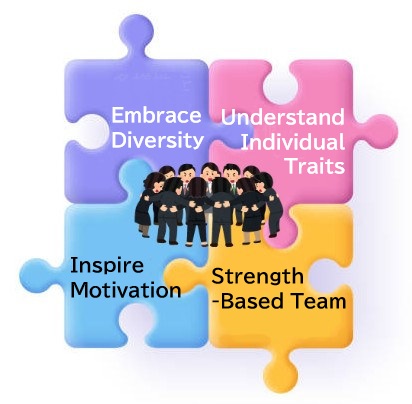
Especially for team leaders, understanding and grasping the traits of team members is essential.
A strong team cannot be built while ignoring trust and human relationships.
For that reason, leaders first need the willingness to accept diversity and make good use of it.
They also need to understand the individual traits of each member and assign appropriate roles.
In addition, leaders need approaches that build team strength by making use of individual strengths and that motivate people and raise their engagement.
In this context, relational elements such as “I want to work under that manager” or “I want to work in an open and energetic team” become extremely important.
Even when the work itself is difficult, the atmosphere of the workplace can become either a highly supportive environment or a deeply difficult one depending on the quality of team relationships.
That is why the leader’s ability to exercise leadership matters so much.
8. Conclusion
By introducing psychological safety, organizations can create an environment where team members feel safe to share their opinions and ideas freely. In such an environment, creativity and innovation increase, problem-solving ability improves, and team performance rises. As trust becomes stronger, cooperation among members deepens, and engagement across the organization also improves. Psychological safety is realized through open communication and a strong support structure, and it becomes an important foundation for sustainable growth and long-term success. By building a workplace where people can take on challenges with confidence, organizations can move toward a future that is both stronger and more flexible.
Consulting Services to Make Psychological Safety a Reality
Our consulting services use the 5D Profile Assessment to help create a safe environment in which team members can freely exchange views. By clarifying the traits of each team member and the relationships among them, we help build the foundation for stronger team design and make psychological safety more reliable and practical. This supports a workplace culture where people can exchange views openly and take on new and difficult challenges without fear, while also improving organizational performance as a whole.
"We support the creation of a safe environment that sustains free thinking."
On this page, we explained psychological safety, strong team building, and the improvement of engagement from both the organizational and talent perspectives.
Related Pages
- ▶ Talent Management Is Human Resource Management Version 3
- ▶ Why Talent Management Fails When Organizations Do Not Understand People’s Internal Structure
- ▶ Detailed Explanation of the 5D Profile Assessment
- ▶ Detailed Explanation of the Executive Profile Assessment
- ▶ Detailed Explanation of the Organizational Assessment
- ▶ Column Index