The Egogram is a psychological diagnostic tool that visualizes a person's personality and interpersonal patterns
from the perspective of "ego states," showing how they relate to others and what they think and feel internally.
It is based on the theory of Transactional Analysis (TA), proposed by American psychiatrist Eric Berne in the 1950s.
This theory was further developed in Japan by psychiatrist Shunsaku Noda and others at the Sanno Institute of Management,
and the Egogram was adapted into a more business-friendly form.
① Definition: What is the Egogram (Transactional Analysis-Based) Diagnostic Tool?
Transactional Analysis categorizes human mental activity into five "ego states." The Egogram measures the relative strength of these five states.
- CP (Critical Parent): Critical, rule-focused, normative, and directive thinking.
- NP (Nurturing Parent): Caring, empathetic, and supportive attitude.
- A (Adult): Calm and objective, rational and fact-based thinking.
- FC (Free Child): Free-spirited child, rich creativity, emotional expression, and spontaneity.
- AC (Adapted Child): Conforming child, adjusting to surroundings and meeting expectations.
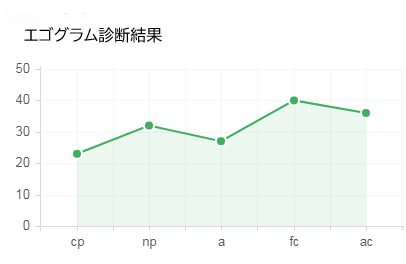
By graphing the balance of these five ego states, the Egogram visualizes a person’s behavioral tendencies and interpersonal patterns.
As shown in the sample, the graph makes it easy to see which states are stronger or weaker at a glance.
The simplicity of the graph means that understanding how to read it is sufficient.
Some diagnostic companies use bar graphs, but the meaning remains the same.
The highest point on the graph represents the dominant ego state of the individual.
Furthermore, when the line connecting the five points forms patterns such as "N-shape" or "M-shape," the diagnosis may state, "Your personality is N-type (or M-type)."
② Background: Why is the Egogram (Transactional Analysis-Based) Diagnostic Tool Noticed?
In business, human relation skills such as leadership, teamwork, stress tolerance, and communication increasingly impact results.
However, typical personality tests only reveal abstract tendencies like "high conscientiousness" or "low extraversion," not the concrete ways people relate to others.
This is where the Egogram has attracted attention.
For example, a person with high CP and low NP may be strict but lacking empathy, causing friction with subordinates.
Conversely, someone with extremely high AC may struggle to express their own opinions and be overly considerate of others.
The ability to infer the psychological background of behavioral patterns is the Egogram’s unique appeal.
③ Features (Strengths): Reasons for the Egogram's High Evaluation
The Egogram typically consists of about 30–50 questions, each corresponding to one of the five ego states.
Responses are mainly in yes/no or Likert scales (e.g., strongly agree to strongly disagree).
Reasons for its high evaluation in business, education, and counseling include:
- Strong at balance assessment: The five ego states are not "high = good" or "low = bad," but rather their balance matters.
For example, high CP, NP, and A combined with moderate FC and AC suggests a rational and humane leader type.
The dominance and suppression of states clearly indicate interpersonal and stress response tendencies. - Visualization of communication styles: Unconscious habits and interpersonal styles such as "too strict with subordinates" or "too deferential to superiors" can be visualized clearly within the PAC balance framework.
This is highly usable in talent development. - Strong for self-feedback: The Egogram is designed so that individuals can gain insight by looking at their own graphs.
The simple bar graph intuitively conveys ego state balance, making it effective for training and self-understanding.
④ Limitations and Issues: Problems with the Egogram (Transactional Analysis-Based) Diagnostic Tool
Although intuitive and simple, the Egogram has three fundamental problems:
- Theoretical coherence is outdated: Transactional Analysis (TA), on which the Egogram is based, was developed in the 1950s and poorly aligns with Big Five, modern cognitive science, and neuroscience.
Simplistic interpretations like "high NP = caring" cannot withstand today’s multifaceted psychological understanding. - Insufficient validation and reliability: Many Egogram versions lack psychometric validation such as factor analysis or reliability coefficients (e.g., Cronbach's alpha).
The questions vary widely between versions and are often not standardized.
As associations comment, "The factor structure, reliability, and validity have not been checked statistically. This is a professional judgment, not a research-grade scale."
Recipients may misunderstand or misinterpret feedback without expert guidance. - Weak connection to behavior: The Egogram captures attitude tendencies but has weak links to concrete behavior patterns or job performance.
Thus, it is inadequate as a basis for hiring, promotion, or placement decisions, serving only as a supplementary tool.
⑤ Conclusion: The Egogram Has Critical Issues of Outdated Theory and Nonconformity to Behavioral Prediction
The Egogram is based on 1950s Transactional Analysis theory, a time when psychology heavily relied on personality and ego state classifications.
Modern multilayered and continuous models like Big Five or cognitive neuroscience were not yet developed.
Therefore, it has fatal flaws as a tool based on a previous generation’s classical psychology.
Issue 1: Overly simplified single-axis model is outdated
The Egogram categorizes human mental functions into only five ego states (CP, NP, A, FC, AC), each fixed and intuitively simplified:
CP: rule-abiding, critical; NP: caring, kind; A: calm, objective; FC: emotional, free-spirited; AC: compliant, reserved.
This rigid description does not reflect actual human behavioral or cognitive flexibility.
While revolutionary in the 1950s for visualizing interpersonal styles, it is clearly outdated by modern psychology and HR standards.
Today’s psychology uses layered, continuous structural models such as the Big Five or cognitive style theories.
Non-hierarchical, non-factor models like the Egogram are considered obsolete by the American Personality Psychology community.
Issue 2: Tool only measures psychological tendencies, not workplace behavior
Due to lack of causal links to behavior, the Egogram results are self-reported internal tendencies and lack theoretical basis for directly predicting actual workplace behavior.
For example, a person scoring high AC (overly conforming) may actually display strong negotiation skills in customer-facing roles.
Someone scoring high A (calm and logical) might have emotional instability in interpersonal relations.
Even if scores indicate "high A, low FC," it is unclear theoretically or empirically whether this person will succeed as a leader, handle stress well, or impact relationships positively.
The Egogram tends to capture thinking tendencies or wishful answers and has weak causal relation to observable job behaviors or outcomes.
It relies solely on self-report without behavioral observation or multi-rater evaluation.
Thus, it is insufficiently evidence-based for major business decisions like hiring, placement, or promotion.
Modern HR tech demands cross-validation with behavioral logs, performance data, and 360-degree feedback.
For example, research shows people high in Big Five agreeableness have fewer team conflicts, and low emotional stability predicts performance drops under stress.
However, the Egogram lacks data or predictive models linked to job performance or behaviors.
Claims such as "high CP correlates with low turnover" or "high FC correlates with sales success" lack reproducible evidence.
Therefore, relying on Egogram results for critical talent decisions is risky.
Issue 3: No rationale for why five ego states yield 29 personality types
Typically, the five scores (CP, NP, A, FC, AC) produce a person’s "personality tendency (Egogram pattern)."
The mathematical problem is that deriving 29 personality traits from only five variables is logically excessive:
- Mapping 5 input variables to 29 outputs directly is logically disproportionate.
- There is no 1:1 correspondence, allowing arbitrariness in how personality quirks are derived.
- Mathematically, with 5 levels per ego state, there are 5⁵=3125 possible combinations; even with 3-level categorization, there are 125.
Reducing these to 29 types ignores mathematical and psychological rigor and implies intentional categorization.
The input-output relationship is a discrete mapping, not a statistical factor or continuous surface.
Diagnosis always shows graphs (bar or line) representing patterns defined as one of the 29.
An evolved form called the Digram diagnostic tool uses 3-level evaluation and defines 31 personality types, but also lacks rationale for these 31 types. - This results in an astrology-like classification.
Without statistical factor classification, the Egogram is an unscientific personality diagnosis.
Psychologists’ interpretations tend to be subjective.
The number of types is chosen for interpretive convenience rather than scientific basis.
Despite this, it remains popular likely because of its high usability rather than scientific reliability or validity.
The above includes the author's personal opinions.