In recent years, companies have increasingly shifted from evaluating candidates primarily on IQ (intellectual ability = academic knowledge) to focusing on EQ (emotional intelligence).
This is not a passing trend, but the result of fundamental changes brought about by today’s VUCA business environment and new approaches to talent management.
What is IQ?
IQ (Intelligence Quotient) is a measure of cognitive ability—academic knowledge such as kanji, idioms, arithmetic, as well as numerical reasoning, verbal comprehension, and logical thinking.
For decades, it has been valued as an indicator of problem-solving and processing speed. In Japan, new graduate exams such as SPI and Tamatebako primarily focus on IQ-related skills.
For details, see Comparison of Aptitude Tests, which explains SPI and Tamatebako.
What is EQ?
EQ (Emotional Intelligence Quotient) is the ability to understand and regulate your own emotions, recognize the emotions of others, and manage relationships effectively.
Unlike IQ, it reflects how you deal with people, handle emotions, and act flexibly in different situations—qualities that define “who you are” and the quality of your behavior.
These do not show up in test scores, but they determine how you respond to challenges, build relationships, and function in the workplace.
EQ includes abilities such as:
- Self-awareness
- Motivation
- Empathy
- Interpersonal skills
① Three Backgrounds Driving the Rise of EQ
The shift can be explained in three ways:
- Background 1. Organizational performance now depends on “quality of relationships”
- Background 2. The VUCA era
- Background 3. Diversity and co-creation
Background 1. Organizational Performance Depends on Relationships
Why are relationships more important than ever?
In today’s organizations, results can no longer be achieved by outstanding individuals alone.
The real challenges—innovation stagnation, rising turnover, mental health issues, and diversity management—stem from the “quality of relationships” within teams and workplaces, not just individual skills.
In project-based and knowledge-intensive work, success depends less on “how many talented individuals you have” and more on “how well they collaborate.”
Workplace relationships now directly determine competitiveness.
Global companies increasingly see emotional infrastructure as the foundation of productivity.
In this context, the concept of Psychological Safety has come into the spotlight.
Proposed by Amy Edmondson, it describes a workplace environment where employees feel safe to share ideas and concerns without fear.
A Google study found that the single most important factor in successful teams was not knowledge or skills, but high psychological safety.
Without it, employees shrink back, fearing rejection or punishment, and fail to perform at their best.
EQ—skills like empathy, emotional understanding, and relationship-building—is the key to creating this safety.
Daniel Kim’s “Success Cycle Model” also highlights how EQ underpins team performance:
- Quality of Relationships
- Quality of Thinking
- Quality of Action
- Quality of Results
The model shows that improving “relationships” first sets off a positive cycle that enhances thinking, behavior, and results.
EQ-driven individuals reduce conflict, listen with empathy, and engage in constructive dialogue, raising team performance in a real, measurable way.
Background 2. The VUCA Era
Today’s business environment is often described as “VUCA”—a time of uncertainty with no single right answer.
VUCA stands for:
- V (Volatility): rapid, unpredictable change
- U (Uncertainty): unclear outcomes
- C (Complexity): intertwined factors
- A (Ambiguity): unclear cause-effect relationships
Reference:
Wikipedia: VUCA (Japanese)
In such times, what matters is not knowing the right answer, but how you act when there is no answer.
EQ enables resilience: the ability to manage stress, adapt flexibly, and collaborate under pressure.
Those with high EQ recover quickly from setbacks, regulate emotions, and move forward without blame.
In the past, flexibility meant adapting to changes in instructions or tasks.
Today, however, adaptation alone is insufficient; continuous self-transformation is essential.
With rapid advances in AI and digitalization, skills become outdated in just a few years.
Talent must not only cope with change but actively reshape themselves—what we call transformative capacity.
Background 3. Diversity and Co-Creation
Modern workplaces bring together people of different ages, genders, nationalities, values, work styles, and expertise.
True organizational strength lies not just in diversity (D), but in inclusion (I)—the ability to collaborate across differences.
Co-creation requires dialogue that embraces differences rather than avoiding or suppressing them, and EQ provides the foundation.
High-EQ individuals approach differences with empathy, creating trust and enabling genuine collaboration.
Empathy—the ability to understand others from their perspective—is the key to making diversity work.
Without it, differences lead to misunderstanding, silence, or superficial harmony.
With it, differences become a source of innovation and resilience.
At the same time, talent management has replaced traditional HR practices.
Talent is no longer just labor—it is the core source of competitiveness.
Talent management involves discovering, developing, and retaining people’s strengths.
EQ plays a central role in this strategy, alongside potential discovery, psychological safety, and strategic placement.
- EQ: Identifying and developing individuals with emotional intelligence
- Potential discovery: Evaluating future growth beyond past achievements
- Psychological safety: Building environments for learning and challenge
- Strategic placement: Aligning strengths with organizational goals
② Changes in Hiring Practices
Companies are increasingly adopting methods such as:
- Interview questions targeting EQ (e.g., “Describe a recent frustrating situation and how you handled it.”)
- Assessment centers with interpersonal scenarios
- Personality tests evaluating workplace adaptation, cooperation, and emotional resilience
- Group work to observe teamwork and collaboration skills
This reflects a structural shift: valuing emotionally agile and empathetic individuals over purely logical ones.
Personality assessments that measure workplace fit, cooperation, and emotional resilience are increasingly used, not only in hiring but also in placement, development, and leadership training.
Key areas of focus include:
- Workplace Adaptability: Flexibility, resilience, initiative, and openness to change.
- Cooperation: Team orientation, empathy, respectfulness, and conflict avoidance.
- Self-control: Emotional stability, pressure tolerance, frustration tolerance, and impulse control.
While IQ testing will not disappear entirely—companies still need to confirm basic academic ability and reasoning—EQ has become indispensable. According to a 2022 Keidanren survey on “qualities sought in graduates,” nearly 80% of companies prioritized “initiative” and “teamwork/leadership/cooperation.”
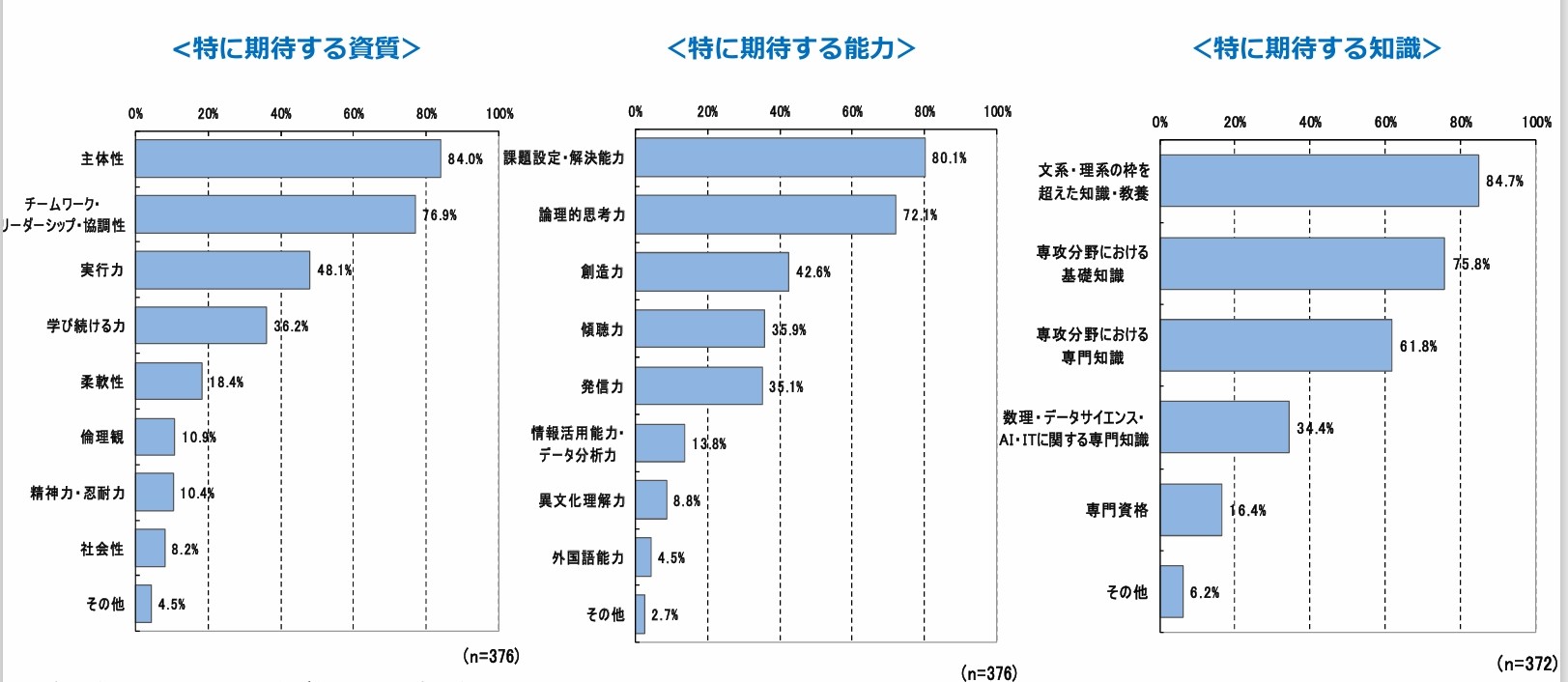
Source: Keidanren 2022 Survey on Desired Talent Qualities