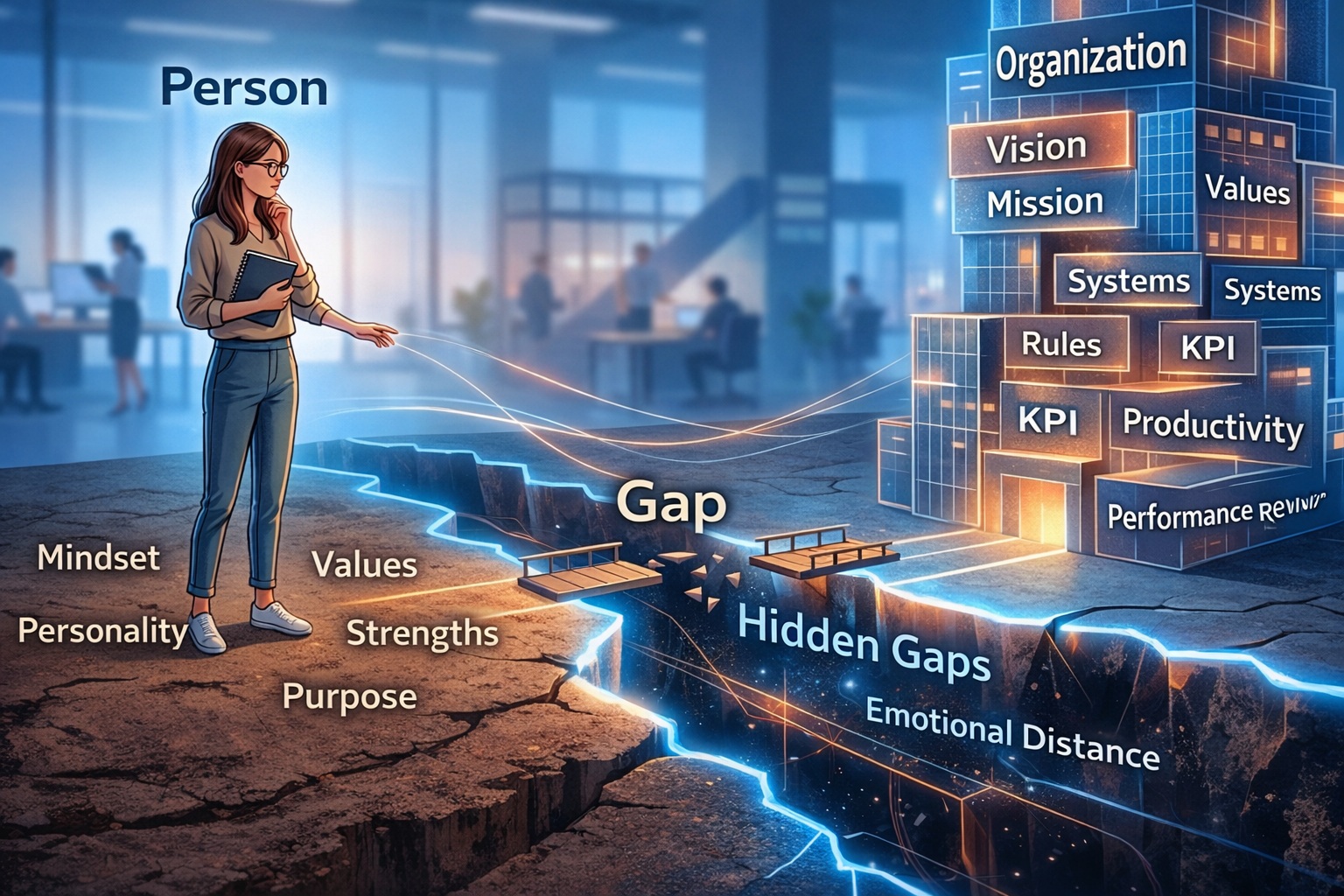
Introduction
In many companies, when a problem occurs, the standard approach to solving it has long been to first review the “task side” of the business, such as work processes, role assignments, rules, systems, and evaluation mechanisms. This is not wrong. In fact, for a long time it was the most rational and reproducible way of thinking. If too much emphasis is placed on individuals as the cause, decisions easily become influenced by likes and dislikes, compatibility, impressions, and personal experience. That is why it was important to first put the “task side” in order.
However, many workplaces today are experiencing a growing sense that people and organizational problems do not disappear, even though systems, evaluation frameworks, rules, 1-on-1 meetings, and management training have all been put in place.
- People who were hired do not perform as well as expected
- Some employees lose their effectiveness as soon as they are transferred
- Even under the same manager, some subordinates grow while others do not
- Even with an evaluation system in place, some people accept it while others become increasingly dissatisfied
- When turnover or poor condition occurs, it is treated as the individual’s problem, and the organizational cause remains unclear
Problems like these can no longer be solved by looking only at the “task side.” Going forward, problem-solving must address not only the improvement of tasks and systems, but also the “people side” at the same time.
“Solving problems on the people side” does not mean blaming individuals. It does not mean deciding that someone is bad, incapable, or unmotivated. It means identifying mismatches in fit between the person and the role, the person and the manager, the person and the work environment, and the person and the evaluation criteria, and solving problems on the assumption that such mismatches exist.
This perspective is essential for solving people and organizational problems in the future.
1. Why Has Problem-Solving Traditionally Focused on the “Task Side”?
There is a clear reason why people have long said, “Look at the task first, not the person.” In the past, there were very few ways to understand human characteristics objectively and structurally.
In general problem-solving methods as well, the basic flow is to define the problem, gather facts, break it down into elements, form hypotheses about the causes, and then consider solutions. Problem-solving methods taught in MBA programs also emphasize this process. The focus is on first grasping the facts and thinking structurally, rather than relying on intuition or impression.
This way of thinking has brought significant value to business management. In particular, Japanese companies developed a culture of seeing problems as issues of “tasks and systems” and improving the mechanisms behind them through accumulated efforts in quality control and operational improvement. By refining workflow, role design, systems, evaluation, and information sharing, they were able to achieve highly reproducible improvements without relying too heavily on individuals.
Also, if too much of the cause is attributed to people, judgment quickly becomes unstable.
- Decisions become based on likes and dislikes
- Problems get dismissed as mere compatibility issues
- Everything gets attributed to lack of ability
- Evaluations become overly dependent on a manager’s subjective view
To avoid these risks, it made the most sense to first put the “task side” in order. In other words, a task-centered approach to problem-solving was not outdated. It was the right approach for its time.
The problem begins here. Today’s workplaces are increasingly facing problems that cannot be fully solved by that way of thinking alone.
2. What Is Happening in the Workplace Today?
In the workplace today, many recurring problems continue to arise even after systems and structures have been put in place. For example:
- Even under the same system, some departments operate smoothly while others do not
- Even with the same manager’s approach, some subordinates grow while others stall
- Even when given the same role, some people produce results while others become exhausted
- Even with the same evaluation system, some people accept it while others become more dissatisfied
- People who looked promising at the time of hiring fail to demonstrate their strengths after joining
- Some people suddenly stop fitting well after a transfer or promotion
- Even if 1-on-1 meetings and interviews increase, honest views still do not surface
- Even when turnover or poor condition occurs, the real reason remains unclear
What these problems have in common is that even if the “task side” is not entirely blameless, those issues alone cannot fully explain what is happening.
If the system alone were the problem, differences in outcomes would not become this large under the same system. If the manager’s approach alone were the problem, reactions would not diverge this much under the same manager.
In other words, workplaces are already facing problems that cannot be fully captured by looking only at the “task side.”
3. The Major Problem Is That “People Problems” Are Not Being Handled Properly
What needs to be said here is clear. Many companies have taken “task-related problems” seriously. However, they cannot be said to have dealt adequately with problems involving “people.”
The reason is that the moment we try to deal with “people,” ambiguity quickly enters the picture.
- That person lacks initiative
- That person is too fragile
- That manager and employee are simply incompatible
- That person is not suited for management
Such expressions are frequently used in the workplace. But when people speak this way, the cause remains vague. Evaluation, impression, and fact all become mixed together.
As a result, “people problems” tend to be treated either as matters of blame or as subjective impressions. In other words, they are easily reduced to “the problem is with that person,” which makes it difficult to reach a fundamental solution.
- It gets treated as a matter of the individual’s mindset
- It gets dismissed as a compatibility issue between manager and subordinate
- It gets reduced to lack of effort in the workplace
- Neither role reassignment nor changes in managerial approach become clear
This is the major limitation. The reason people and organizational problems remain unsolved is not that “people” are unimportant. It is that, although they are important, they are not being handled structurally.
4. The Real Cause Lies in the “Mismatch of Fit” Between People and Organizations
So what should we really be looking at? It is not whether there is a problem with the person. What we should look at is what kind of mismatch of fit exists between the person and the organization.
Examples of this kind of mismatch include the following:
- A mismatch between the person and the role
- A mismatch between the person and the manager in terms of work values and way of interacting
- A mismatch between the person and the work environment
- A mismatch between the person and the evaluation criteria
- A mismatch between the person and the way results are expected to be delivered
- A mismatch between the person and the way of working the organization expects
- A mismatch between the person and the work values the organization emphasizes
When this mismatch is large, even a capable person with a strong track record may find it difficult to perform. Even if a manager engages without bad intent, the subordinate may experience it as pressure. Even if a system appears correct, it may still cause people in the workplace to lose their sense of fairness and acceptance.
In other words, many people and organizational problems need to be reframed not as issues of whether a person is good or bad, but as issues of mismatch. Without this perspective, problem-solving inevitably remains shallow.
In psychology and management studies, this way of thinking is not unusual at all. The idea that a higher level of fit between an individual and the environment leads to higher retention and stronger performance has long been emphasized in organizational research.
In modern organizational development as well, it is now common to focus not only on visible outcomes, but also on the quality of relationships and mutual understanding behind those outcomes. In other words, this is the stage at which “people” should no longer be handled through intuition, but through structure.
5. Why a New Axis of “People” Must Be Added to the Traditional Approach
What should not be misunderstood here is that this proposal is not saying that traditional problem-solving was wrong. Quite the opposite.
The fact that many companies have focused on “tasks” rather than “people” was, for a long time, an extremely rational and correct way of thinking. Japanese companies built high quality and stable workplace operations by accumulating efforts in standardization, process design, role clarification, quality control, prevention of recurrence, and continuous improvement, as symbolized by QC activities and kaizen.
In other words, the idea of “look at the task first, not the person” was not just a theory. It was a successful principle that supported the competitiveness of Japanese companies.
However, there is one important thing that should not be overlooked. During the period from the 1970s to the 1980s, when QC and improvement activities were highly active, Japanese workplaces were not operating only on the basis of “tasks and systems.”
Managers in those days probably took much closer care of their subordinates than managers do today. This meant not only overseeing how work was done, but also paying attention to each person’s strengths and weaknesses, personality tendencies, changes in condition, and even human relationships, almost as if they were family. So although improvement efforts outwardly focused on “tasks,” in practice managers absorbed a great deal of the mismatches and problems related to “people” through their day-to-day involvement.
- If a subordinate became intimidated, the manager would speak to them
- If a subordinate struggled in a role that did not suit them, the manager would adjust how the role was assigned
- If there was dissatisfaction or hesitation, the manager would pick it up through everyday contact
- Even when strict, the manager would ultimately continue to support the subordinate
This kind of intensive human support was common in workplaces at the time. In other words, past Japanese companies were strong not only in putting the “task side” in order, but also in the corrective power of managers on the human side. That is why, even though problem-solving appeared to be task-centered, many “people issues” were in fact being handled within day-to-day management.
Today, however, that premise has changed significantly. Cost pressure, the spread of performance-based management, downsizing, heavier managerial burdens, the diversification of employee values, and greater labor mobility have all changed the environment. As a result, today’s managers no longer have the room to observe each subordinate carefully and absorb mismatches through everyday involvement in the way they once did.
One especially important factor is the rise of the player-manager. Today’s managers are expected to produce results themselves while simultaneously handling subordinate management, development, evaluation, 1-on-1 meetings, and labor-related care. Under these conditions, it is no longer easy to understand the characteristics and condition of each subordinate in detail and absorb mismatches through daily interaction as managers once did.
This point is extremely important in understanding today’s people and organizational problems. In the past, after systems and structures were put in place, workplaces were ultimately sustained by the manager’s human support. Today, however, that “final correction function” has weakened. As a result, mismatches that would once have been absorbed naturally in the workplace are now more likely to surface as visible problems.
- Even under the same manager, some subordinates grow while others become intimidated
- Some people lose their effectiveness as soon as they are transferred
- Even with an evaluation system in place, some people accept it while others become increasingly dissatisfied
- Even when turnover or poor condition occurs, it is treated as the individual’s problem, and the organizational cause remains unseen
These are not merely defects in systems. They are signs that the mismatches between people and organizations that managers and workplaces once absorbed can no longer be absorbed sufficiently.
This is because many of today’s problems are not issues that remain after the “task side” has been improved. They arise from the outset with mismatches in fit between people and the organization. Modern organizational theory and management research increasingly emphasize this perspective as well. When we trace the causes of poor results, we often arrive not only at systems and procedures, but also at human factors such as trust, psychological safety, mismatched values, and differences in role recognition.
Therefore, future problem-solving must involve not only checking whether there is a problem in the “task side,” but also looking at whether there is a mismatch in fit between people and the organization, and then reviewing placement, interaction, expectation-setting, development methods, and evaluation practices on the basis of both.
In the past, “people issues” were absorbed and handled through the proactive involvement of managers. In some respects, that style of involvement was passed from one generation of managers to the next as an unspoken assumption. In today’s environment, however, although managers are still expected to play that role, the mechanisms required to fulfill it have not been fully established. As a result, dealing with “people” remains not a structured organizational capability, but something still left largely to the individual manager’s ability and spare capacity.
6. What Can Be Solved by Adding the Axis of “People”?
The value of adding the axis of “people” to problem-solving is not simply that it makes management more considerate. Its real value lies in making it possible for organizations to treat matters that have long been handled vaguely as “the individual’s problem,” “compatibility with the manager,” or “lack of effort in the workplace” as issues that can actually be improved.
Traditional problem-solving has improved many issues by reviewing the “task side,” such as systems, work processes, role sharing, and evaluation practices. This remains important today. However, in modern companies, problems that cannot be fully explained by those factors alone are increasing. And in Japanese companies, even if it is clear that a person is not in the right role, it is almost impossible in practice for the person to request a transfer on their own. Unless there is illness or a very special circumstance, it is difficult to say openly, “This job does not suit me.”
Also, even if reassignment is necessary from the perspective of proper fit, it may be perceived as a demotion, or it may create an awkward situation in which a former manager is placed under a younger manager. In such cases, both the individual and those around them may find it difficult to function smoothly, and the organization itself may lose effectiveness. This is often an even more serious problem in small and medium-sized companies.
In addition, in recent years, not only companies that still strongly retain seniority-based or lifetime-employment systems, but also companies that have introduced performance-based management and therefore have more combinations of younger managers and older subordinates, have increased. With the spread of reemployment systems as well, workplaces increasingly include people of different ages, experience levels, role expectations, employment expectations, and values working side by side. Under these conditions, it is no longer enough to say, as in the past, that managers simply need to take care of their people. Communication itself is becoming an organizational issue.
That is why issues concerning “people” should not be examined only after problems arise. They need to be looked at much earlier. Before hiring, before promotion or appointment, before assigning roles, before deciding project placement, and before transfers, it is important to examine fit between people and the organization in advance so that major mismatches do not arise in the first place.
At the same time, however, we must also recognize reality. Especially in small and medium-sized companies, labor shortages are severe, and it is not easy to realize an ideal form of placing the right person in the right role. When there are not enough people, the priority is often not “Is this the best person for this role?” but “How can we make things work with the people we have right now?”
That is why the idea of “looking at fit between people and organizations” may sound like an idealistic luxury. But the point of this section is not to aim for perfect placement. Even with limited personnel, it is important not to overlook clearly large mismatches, to avoid assigning roles in unreasonable ways, and to prevent a decline in organizational functioning by adjusting how people are managed and what expectations are set.
In other words, the purpose of looking at “people” is not only to realize ideal HR decisions. It is also to identify, at an early stage, practical measures that can be taken within realities that cannot easily be changed. A separate white paper addresses the structural issue of labor shortages themselves and ways to respond to them.
This section focuses instead on how to make the best use of the people already in place and how to reduce avoidable mismatches in advance, regardless of whether labor shortages exist.
By adding this perspective, companies can more easily improve the following:
Reducing failures in placement and transfers
Until now, placement and transfers have often been decided mainly on the basis of performance, experience, seniority, and workplace evaluation. In reality, however, even if two people have the same ability, their results differ depending on how well they fit the role. If fit between the person and the role is examined, it becomes easier to reduce mismatches in advance, such as a person losing momentum after a transfer or failing to demonstrate the level of performance that was expected.
Reducing mismatches in promotion and appointment
A person who performs well in the field does not necessarily perform well as a manager. In the past, Japanese companies could absorb this mismatch to some extent because managers had time to develop subordinates carefully over a long period. Today, however, with the spread of the player-manager role, managers no longer have the room to observe each subordinate carefully in the way they once did. That is why, before promotion or appointment, it is necessary to examine whether the person will fit the demands of the new role. Otherwise, both the individual and the organization will struggle.
Reducing misalignment between managers and subordinates
The same way of communicating may resonate with one person and intimidate another. The same guidance may be taken positively by one person and as strong pressure by another. Today, more companies are introducing performance-based management, leading to more combinations of younger managers and older subordinates. In addition, with the spread of reemployment systems, workplaces increasingly contain people with different ages, experience, employment expectations, and values. In this environment, it is no longer enough to say that managers should simply “take care of their people.” Communication itself becomes a source of organizational difficulty. That is why it is more important than ever to think about how to engage with people based on differences in thinking, emotions, and behavior.
Increasing acceptance of evaluations and 1-on-1 meetings
The mere existence of an evaluation system or regular 1-on-1 meetings does not create acceptance. If it is not visible what the person values in work, in what kind of environment they are likely to perform well, and what kind of approach they are most likely to receive well, then both evaluations and conversations tend to remain superficial. By examining fit on the people side, it becomes easier to improve how evaluations are communicated, how expectations are set, and the quality of dialogue in 1-on-1 meetings.
Helping prevent turnover and poor condition
Turnover and poor condition rarely appear suddenly. In many cases, they surface as the accumulated result of mismatch. In Japanese companies, however, even when turnover or poor condition occurs, it is often ultimately treated as the individual’s problem, while the organizational causes remain vague. If fit between people and the organization can be seen at an earlier stage, it becomes easier to adjust managerial interaction, role assignment, expectation-setting, and evaluation practices before the problem becomes serious.
In other words, adding the axis of “people” does not mean increasing intuitive or impression-based management. On the contrary, it means being able to handle what was previously vague in a more concrete, more realistic, and earlier way.
7. A New Solution: Handling “Tasks” and “People” at the Same Time
What we would like to propose here is simple: from now on, problem-solving should not be based only on improving the “task side.” It should be based on handling both “tasks” and “people” at the same time.
In traditional problem-solving, organizations first reviewed the “task side,” such as systems and workflows, and then relied on workplace effort or managers’ individual responses to absorb whatever problems remained. This method worked in the past. That is because, in earlier Japanese companies, even though improvement efforts outwardly focused on the “task side,” managers were in practice watching over subordinates almost like family and absorbing many people-related issues through daily interaction. That style of involvement was also passed on, implicitly, as managers became the next generation of managers.
Today, however, that premise has collapsed. Managers are still expected to develop subordinates and provide human support. But the mechanisms necessary for them to fulfill that role have not been established sufficiently, and the reality is that it is still left to each individual manager’s ability and available time. Especially now that player-managers are common, it is no longer easy for managers to observe each subordinate’s condition and characteristics carefully and absorb mismatches in the way they once did.
As a result, many of today’s problems are not issues that remain after the “task side” has been improved. They arise from the outset with mismatches in fit between people and the organization. Modern organizational theory and management research increasingly emphasize this point. When we trace the causes of weak performance, we often arrive not only at systems and procedures, but also at human factors such as trust, psychological safety, mismatched values, and differences in role recognition.
In other words, even if only the “task side” is fixed, the same problems will reappear in different forms if the fit between people and the organization remains misaligned. That is why it is already too late to look at “people” only after a problem has occurred. Before hiring, before promotion, before deciding roles, before assigning projects, and before transfers, both the “task side” and the “people side” must be examined in advance.
One important point here is that handling “tasks” and “people” at the same time does not mean adding unrealistic ideals. Especially in small and medium-sized companies, where labor shortages are severe, it is not easy to realize an ideal version of placing the perfect person in the perfect role. The reality is that companies often do not have the luxury of choosing. They have to make things work with the people they already have. Even so, there is still great value in examining fit between people and the organization. That is because even if perfect placement is impossible, organizations can still avoid overlooking clearly major mismatches, avoid assigning roles in unreasonable ways, and adjust the way people are managed and what is expected of them.
This approach can be organized into the following three steps:
- First, check whether there is a problem on the “task side”
Review whether there is anything unreasonable in systems, roles, workflow, evaluation practices, information sharing, or reporting lines. If the discussion begins with “people” without first examining this, it easily turns into a subjective argument. That is why, as before, looking at the “task side” remains important. - At the same time, examine whether there is a mismatch in fit between people and the organization
What should be examined here is the kind of mismatch that exists between the person and the role, the person and the manager, the person and the environment, the person and the evaluation criteria, and the person and the work style the organization expects. The important point is not to decide whether the individual is bad or deficient. It is to examine structurally where the mismatch in fit exists. - Then decide on actions based on both
If the cause lies in the “task side,” revise the system or its operation. If the cause lies in fit between people and the organization, revise placement, managerial approach, expectation-setting, development methods, or the way evaluations are communicated. If both are involved, address both sides. This way of thinking makes it possible to avoid oversimplifying the issue into either “the system’s fault” or “the individual’s fault,” and instead distinguish causes in a way that reflects reality.
In the past, “people issues” were absorbed and handled through the proactive involvement of managers. In some respects, that style of involvement was passed from one generation of managers to the next as an unspoken assumption. In today’s environment, however, although managers are expected to play that role, the mechanisms required to fulfill it have not been fully established. As a result, dealing with “people” remains not a structured capability, but something still dependent on each manager’s individual ability and available capacity.
By changing the approach in this way, problem-solving changes in the following ways:
- It no longer becomes biased only toward systems and structures
- It does not drift into intuitive or impression-based judgments about people
- It allows workplace discomfort and friction to be handled as structural issues
- It no longer depends only on the individual manager’s skill or personal attentiveness
- It gives executives, HR, and line managers a shared language for discussion
- It makes it easier to reduce mismatches before hiring, appointment, placement, development, and evaluation
In short, handling “tasks” and “people” at the same time is a practical approach for today’s Japanese companies. Precisely because it is so difficult to move people around once a problem has already surfaced, organizations need a way to identify mismatches early and act before they become larger problems.
8. The Business Tool That Supports This New Solution Is the 5D Profile Assessment
So how can we look at “people” in a structural way? What is needed here is a tool that makes visible, without relying on intuition or impression, both human characteristics and the mismatches between those characteristics and the organization. That is the role of the 5D Profile Assessment.
The 5D Profile Assessment does not view people from only one angle. It captures them three-dimensionally through the following five perspectives:
- Personality traits
- Emotional traits
- Cognitive traits
- Behavioral traits
- Work values traits
Its value does not lie in being a simple personality test. Its value lies in making it possible to see, more structurally than before, the mismatches that exist between the person and the role, the person and the manager, the person and the organizational environment, and the person and the evaluation system.
For example, a person who appears on the surface to “lack initiative” may in fact be experiencing one of the following:
- Their way of thinking does not align with that of the manager
- They are becoming intimidated in an environment with high emotional pressure
- The behavior being demanded does not match the person’s strengths
- The way they are evaluated does not align with their work values
Once these differences become visible, “people” can finally be handled as a target of problem-solving in a calm and practical way.
9. Conclusion
Until now, it has been common sense that problem-solving should focus primarily on the “task side.” And for a long time, that has been established as the correct way of thinking.
However, it is now becoming clear that this alone cannot fundamentally solve people and organizational problems. That is because many of the problems occurring in today’s workplaces arise not only from the “task side,” but also from mismatches in fit between people and the organization.
That is why, from now on, in addition to solving problems on the “task side,” organizations must also solve problems on the “people side” at the same time. And to do that, people must be seen not through intuition, but through structure.
The 5D Profile Assessment is the practical business tool that supports this new way of solving problems.
There are things that do not change simply by putting systems in place. There are things that do not change simply by increasing training. There are problems that cannot be solved simply by revising the evaluation system.
At that point, what should be examined next? The answer is fit between people and the organization. We hope this proposal will provide your company with a new perspective for reconsidering people and organizational problems.
Reference: Organizational Improvement Guide — A Scientific Approach to Resolving Mismatches Between People and Organizations
In modern organizational management, declining performance and employee turnover are often caused not by “lack of individual ability,” but by “structural mismatches between people and the organization.” This section explains how to analyze those mismatches and the steps required to resolve them.
1. The Four Types of Mismatch That Undermine Organizations
Organizational problems arise from mismatches in the following four categories.
| Category | Definition | Example of a Specific Problem |
|---|---|---|
| 1. Trait Mismatch | A mismatch in thinking patterns and behavioral tendencies | Friction in pace and working style between a cautious subordinate and a manager who makes immediate decisions. |
| 2. Values Mismatch | A mismatch in work values and motivation | Trying to motivate someone who values social contribution only through numbers and results. |
| 3. Environment Mismatch | A mismatch between aptitude and role | Placing a pioneer-type person in a maintenance role, or assigning a highly sensitive person to a harsh work environment. |
| 4. Leadership Mismatch | A mismatch in leadership style | Using an overly directive style with a team that prefers autonomy, leading them to stop thinking for themselves. |
2. A Hybrid Method That Incorporates “People” into Root Cause Analysis
In addition to improving the “task side” of systems and processes, this method incorporates the “people side” of fit as an objective variable in the analysis.
- Check the “task side” (systems): Examine whether there are flaws in systems, roles, workflow, and evaluation practices.
- Check the “people side” (mismatch): Use the 5D Assessment or similar tools to make visible the fit between the person and the role, manager, and environment.
- Take optimization actions: Based on data from both sides, review placement, appointment, managerial approach, and development.
3. Theoretical Background (Evidence)
This approach is based on insights from modern organizational theory and psychology.
3-1. “Quality of Relationships” Determines “Quality of Results” (Daniel Kim’s Success Cycle Model)
This model was proposed by a professor at the Massachusetts Institute of Technology (MIT). It argues that to produce results, organizations must first improve the quality of relationships so that the quality of thinking and action can rise. ▶ View external link (Nihon no Jinjibu)
- Evidence: When the causes of poor performance are examined, they often lead to problems in the “quality of relationships,” such as conflict and blame-shifting.
- Conclusion: Even if only the “task side” is fixed, if mutual understanding and trust among members do not improve, thinking and behavior stagnate, and the same problems on the “task side” are likely to recur.
3-2. “Psychological Safety Determines Productivity” (Google’s Project Aristotle)
Google’s research on labor productivity found that the common factor among highly productive teams was not individual skill, but psychological safety — the ability to take interpersonal risks within the team. ▶ View external link (Nikkei)
- Evidence: The factor that most strongly influenced team performance was not individual ability, but psychological safety.
- Conclusion: Human factors such as leadership style, acceptance, and empathy within the team become decisive drivers of business success or failure.
3-3. Values Misalignment: Edgar Schein’s Career Anchor Theory
This theory, proposed by a former MIT professor, concerns the values that people are unwilling to give up when building their careers. When a person’s non-negotiable values do not align with what the organization offers, serious maladjustment and turnover can result.
- Evidence: Schein defined eight major patterns of values that people place highest importance on in work, and showed that when an organization’s reward system or culture does not align with those values, performance declines and psychological withdrawal can occur.
- Conclusion: Even when skill is present, motivation that does not align with the individual’s values will not function. It is important to analyze values and create points of connection between personal motivation and organizational direction.
3-4. Mismatch in Role Recognition: Robert Kahn’s Role Theory
This theory, proposed by organizational psychologists, concerns the gap between surrounding expectations and the individual’s own understanding of their role. When others’ expectations diverge from the person’s self-recognition, role conflict occurs and performance declines. ▶ View external link (Nihon no Jinjibu)
- Evidence: When contradictions arise between “expectations for the role” and “acceptance of the role” within an organization, individuals experience strong stress and the quality of their decisions declines.
- Conclusion: Many organizational problems arise not from lack of ability, but from mismatched expectations — in other words, from buttons being fastened incorrectly from the start.
3-5. From “Selection and Concentration” to “Adaptation and Placement” (Fit Theory)
This is the Person-Environment Fit theory in psychology and management studies. It suggests that the more closely an individual’s personality traits align with the environment, the higher their satisfaction, retention, and performance will be. ▶ View external link (Rikkyo University paper)
- Evidence: Data has accumulated showing that when a person’s traits and environment are well aligned, turnover is lower and performance is higher.
- Conclusion: Behind the appearance that “someone cannot do the job,” there is often an environment that does not fit the person’s characteristics. That is why excluding “people” from the analysis is not logically sound.