
The Tuckman Model is a framework that explains the process a team or organization goes through from formation to producing results as a step-by-step growth process.
A team does not function effectively from the very beginning. More often, it passes through stages of awkward relationships, conflict of opinions, and unclear roles, before gradually becoming able to deliver results.
The Tuckman Model organizes this team development process into five stages: “Forming → Storming → Norming → Performing → Adjourning”. It is used as a practical judgment framework for understanding the team’s current state and managing it appropriately.
1. Definition
The Tuckman Model is a team development model that explains the process a team passes through before it can produce results, using five stages: formation, conflict, alignment, performance, and closure.
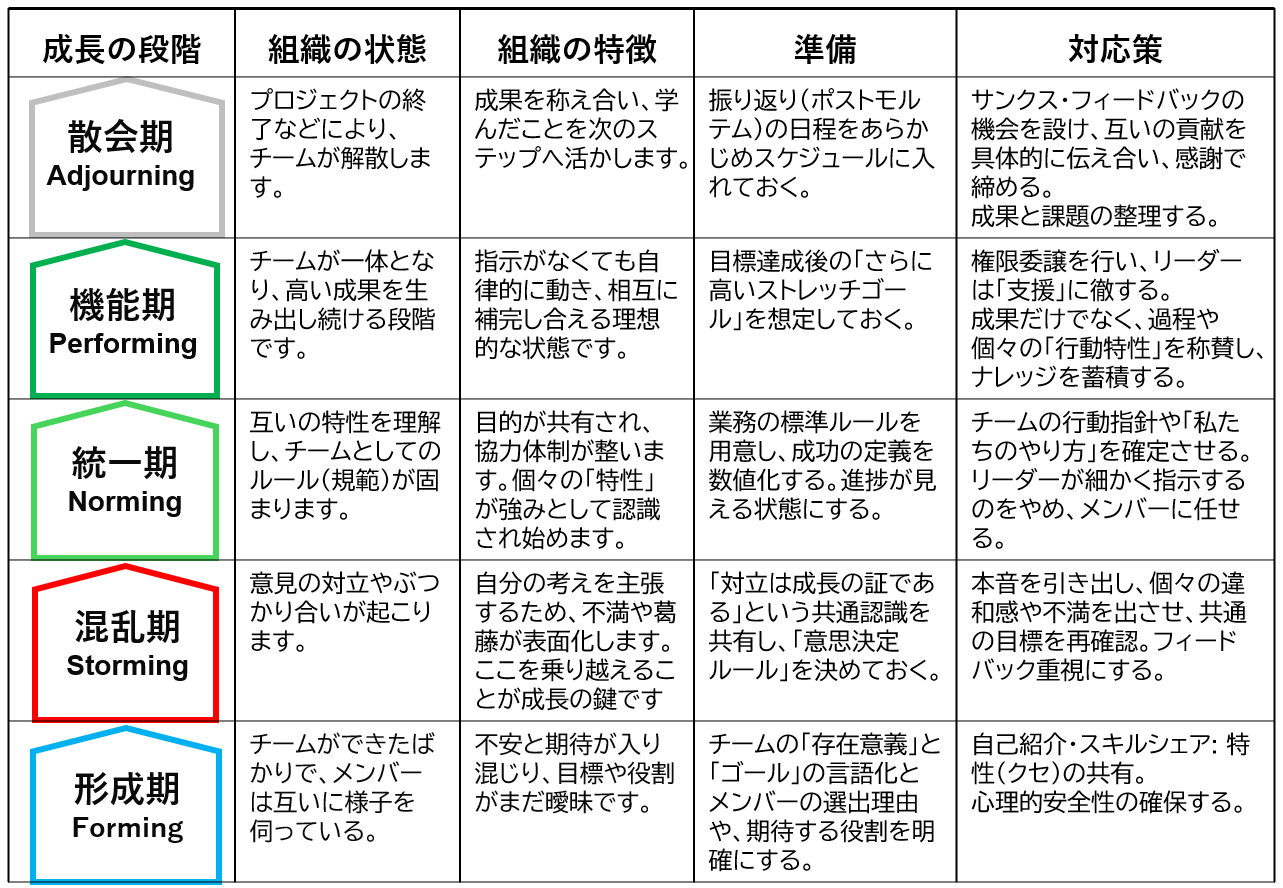
To view the chart in more detail, click the image or use ▶ Enlarge the chart.
Each stage can be organized as follows.
- Forming: a stage in which relationships are still shallow and roles and purpose are unclear
- Storming: a stage in which differences of opinion and conflict begin to surface
- Norming: a stage in which rules and roles become clearer and relationships stabilize
- Performing: a stage in which the team can collaborate autonomously and deliver results
- Adjourning: a stage in which the team completes its role and moves on
In other words, the model shows that a team should not be designed on the assumption that it will grow in a straight line. It should be designed on the premise that conflict and confusion are part of the path to becoming functional.
2. Meaning
The meaning of the Tuckman Model lies in viewing team problems not as “abnormal,” but as part of a developmental process.
In practice, when conflict or confusion arises, it is often treated as a problem of poor member compatibility or weak management. In many cases, however, it is simply a natural condition of the Storming stage.
Without understanding this model, organizations may suppress the very conflicts that need to be worked through, preserve only surface-level harmony, and as a result leave the team stuck in a non-functional state.
By contrast, when the stages are understood, it becomes easier to judge calmly “what stage the team is in,” “what is happening,” and “what should be done next.”
3. Value
The value of the Tuckman Model lies in helping people avoid misdiagnosing the state of a team.
For example,
- There is conflict → the team is bad
- The team looks united → it is a good team
These simple judgments often do not match reality.
In reality,
- The presence of conflict often means the team is in a growth process
- The absence of conflict may mean that people are not voicing their opinions
This is the actual structure behind many teams.
By using the Tuckman Model, it becomes possible to understand the state of a team not through vague impressions, but through structure.
This is highly important in management. If the state of the team is misunderstood,
- unnecessary intervention may occur
- necessary conflict may be stopped
- the real issue may be overlooked
and those judgment errors can prevent the team from developing properly.
Therefore, the value of the Tuckman Model lies in serving as a judgment framework for correctly understanding the condition of the team.
4. Advantages
- Makes it possible to understand the state of a team objectively
- Makes it easier to interpret conflict and confusion correctly
- Makes it easier to choose appropriate management responses
- Makes it possible to design teams on the assumption of growth stages
- Improves the repeatability of team building
- Makes it easier to understand problems structurally rather than blaming individuals
5. Disadvantages
The Tuckman Model is useful, but it can be misused if it is oversimplified.
First, teams do not always move through the stages in a straight line. Depending on the situation or changes in team members, they may return to earlier stages multiple times.
Second, there is little value in knowing the stages alone. What matters is being able to choose management actions that fit the current stage.
Third, if everything is explained only as a stage issue, important problems related to individual capability or role design may be overlooked.
6. Role in Practice
The Tuckman Model should be positioned as a foundation for understanding team conditions in team management.
In practice, it is important first to identify which stage the team is currently in. Based on that,
- Forming: clarify purpose and roles
- Storming: support dialogue and relationship adjustment
- Norming: establish rules and shared agreement
- Performing: delegate authority and encourage autonomy
and then choose the appropriate response.
This model is also closely connected with
Psychological Safety,
Followership,
leadership, organizational and business purpose, role clarity in the organization,
and the building of good communication and trust through the
Organizational Success Cycle Model,
as well as with the importance of recognizing and accepting diversity.
In particular, during the Storming stage, if Psychological Safety is absent, conflict will not become constructive, and the team faces a much higher risk of dysfunction and breakdown.
For that reason, the Tuckman Model should not be treated as just a theory. It should be used as a practical tool for assessing the state of a team and selecting the right intervention.
In short, the Tuckman Model is a foundational concept for understanding team development not through intuition, but through structure.