
The Organizational Success Cycle Model is the idea that sustainable results do not begin with pushing for outcomes first, but with improving the quality of relationships among people. When the quality of relationships improves, the quality of thinking, the quality of action, and the quality of results rise in sequence, allowing the organization to keep producing results over time.
This model understands organizational performance as a flow of “quality of relationships → quality of thinking → quality of action → quality of results.”
The starting point is never results. It is relationships. When foundations such as trust, respect, dialogue, empathy, and
psychological safety
are in place, people are more able to think openly, act proactively, and create results.
The quality of relationships that makes people feel, “I trust this leader and want to follow them,” becomes the starting point of the organization’s success cycle.
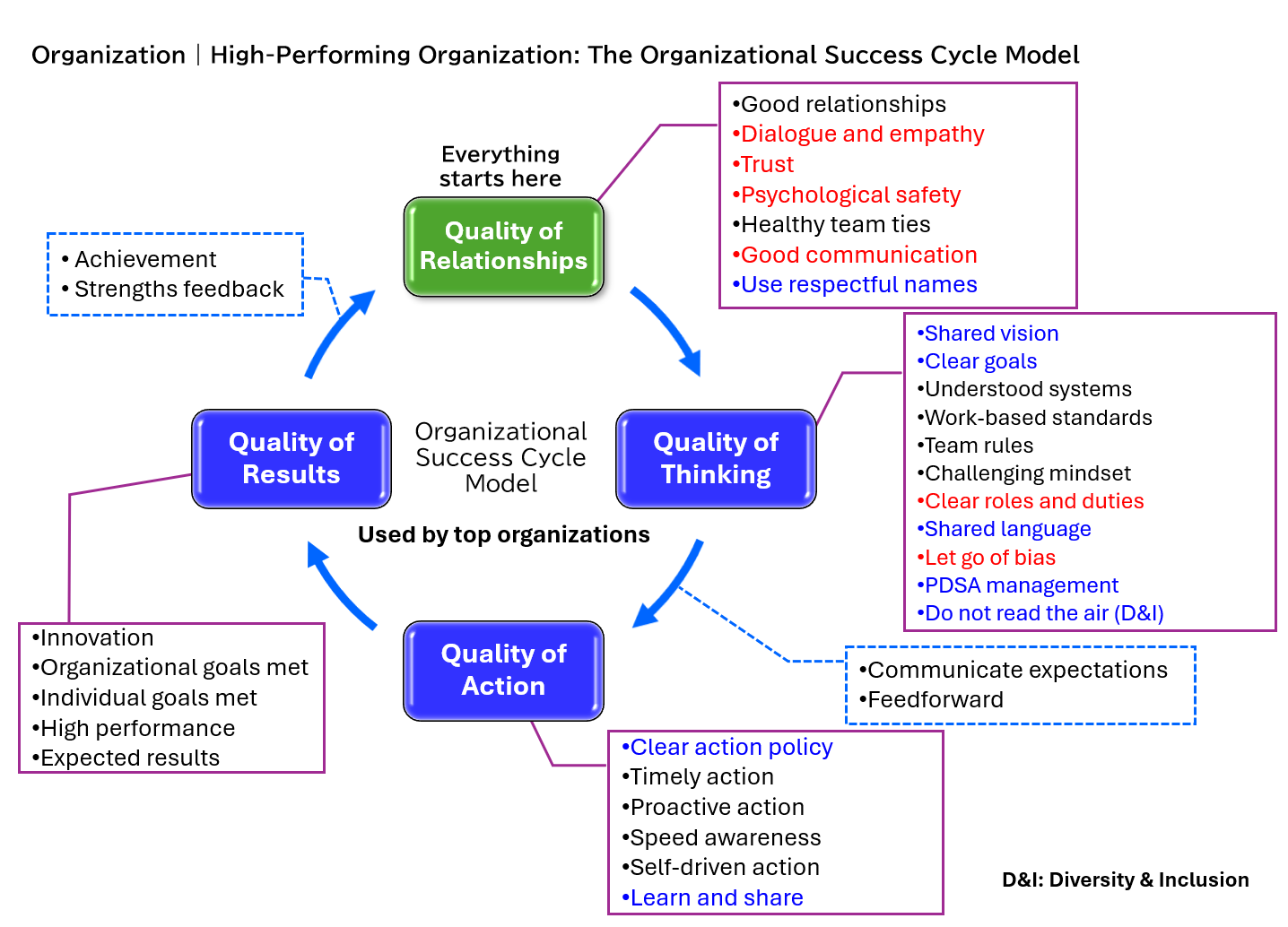
By contrast, when organizations focus only on results, they are more likely to create blame, hesitation, silence, and superficial compliance. That is how organizations fall into a negative cycle. The Success Cycle Model is a practical way to rethink result-driven management that is too short-term, and to make the growth of people and organizations more sustainable and repeatable.
1. Definition
The Organizational Success Cycle Model is a management model that views organizational results not as isolated outcomes,
but as a cycle in which the quality of relationships, the quality of thinking, the quality of action, and the quality of results are linked together.
The four qualities are defined as follows.
The Organizational Success Cycle Model is made up of four linked qualities: “quality of relationships → quality of thinking → quality of action → quality of results”. These are not separate concepts. Each one creates the conditions for the next. First, let us look at the definition of each quality.
① Quality of Relationships
The quality of relationships refers to the state of trust, psychological safety, and mutual respect among people in the organization.
More specifically, it includes whether dialogue takes place, whether people can speak openly without fear, whether there is a willingness to understand the other person’s position, and whether commitments are kept.
When the quality of relationships is high, psychological safety is present, people become less defensive, and members are more willing to think honestly, speak up, and cooperate.
② Quality of Thinking
The quality of thinking refers to the level at which the organization and its people understand, interpret, judge, and set direction.
More specifically, it includes whether vision and purpose are shared, whether decision criteria and rules are clear, whether roles and responsibilities are organized, and whether people can think flexibly rather than being trapped by assumptions.
When the quality of thinking is high, individual judgments become more aligned, organizational direction becomes clearer, and people are able to make positive decisions with less confusion.
③ Quality of Action
The quality of action refers to the level of execution in how the organization and its people act in practice, and how they use those actions for continuous improvement.
More specifically, it includes having clear action guidelines, being able to act in a timely way, acting proactively, and reflecting on actions in order to learn and improve the next step.
When the quality of action is high, people do not simply wait for instructions. Autonomous action emerges, and the organization is able to execute consistently and improve continuously.
④ Quality of Results
The quality of results refers not only to numerical outcomes, but to a state in which both the organization and the individual produce results with a sense of achievement, and connect those results to future growth.
More specifically, it includes not only achieving targets, but also sharing outcomes, feedback, accumulated learning, and linking results to the next challenge.
When the quality of results is high, outcomes do not end as one-time achievements. Trust, ways of thinking, and learning accumulate as organizational knowledge, and this in turn strengthens the next cycle of relationship quality.
This model mainly includes the following elements.
- Taking the quality of relationships as the starting point
- Understanding that trust and psychological safety support positive thinking
- Recognizing that the quality of thinking shapes the quality of action
- Recognizing that the quality of action leads to the quality of results
- Returning results to the next cycle of trust and dialogue so the cycle continues
In short, the Success Cycle Model does not see organizational results as one-time output to be managed, but as part of a continuous growth process that begins with human relationships.
2. Meaning
The meaning of the Organizational Success Cycle Model lies in not explaining results only in terms of individual ability or lack of effort, but in looking at the quality of organizational relationships and dialogue that exists before results appear.
In practice, when results are not achieved, organizations often look for answers in stricter evaluation systems, tighter goal management, or stronger control. However, when the quality of relationships is low, people find it harder to speak honestly, their thinking becomes shallow, and their behavior becomes more passive. In an organization in that state, systems, rules, and procedures do not function as intended, even if they formally exist.
This model offers a reversal in perspective: if you want better results, start by improving relationships. For management, it clarifies the conditions needed before systems and strategy can truly work. For HR, it means treating trust, dialogue, and psychological safety not as vague matters of atmosphere, but as the foundation for organizational performance.
3. Value
The value of the Organizational Success Cycle Model lies in preventing results from depending on luck or on a few individuals.
When organizations start by improving the quality of relationships, people shift from thinking, “How do I avoid being blamed?” to thinking, “How can we make this better?” This raises the quality of dialogue and makes it easier to create early problem detection, constructive discussion, voluntary improvement, and shared learning.
This model also has value because it makes it easier to identify organizational stagnation that cannot be explained by systems or rules alone. It provides a lens for reviewing root causes that are difficult to see through numbers and structures alone, such as lack of trust, lack of dialogue, difficulty speaking up, and avoidance of responsibility.
It also adds value by helping organizations go beyond simply producing results. When results are returned to recognition, learning, and communication of expectations, they become part of the next cycle, making results more repeatable and sustainable.
4. Advantages
- Makes it easier to build an organization on a foundation of trust
- Raises psychological safety and makes it easier for opinions and concerns to surface
- Makes it easier to detect problems early and respond early
- Improves the quality of thinking and makes constructive discussion easier
- Makes it easier to draw out initiative and improvement-oriented action
- Makes results more repeatable instead of one-off
- Makes it easier to shift management from control-centered to support-centered
- Makes systems and strategy more likely to function in the workplace
Especially in practice, a major advantage is that when results are weak, it becomes easier to review not only the individual, but where the cycle is breaking down across relationships, thinking, and action. This makes it less likely that countermeasures will be limited to superficial tightening of control.
5. Disadvantages
The Organizational Success Cycle Model is effective, but it also comes with practical challenges.
First, the emphasis on relationship quality is often misunderstood as simply getting along well or creating excessive comfort. In reality, it is meant to provide the foundation for honest dialogue and responsible collaboration. If handled superficially, however, it can lead to a loose organization without standards or necessary rigor.
Second, it can take time before results become visible. The quality of relationships does not improve in a short period the way a system change might. It grows through the accumulation of everyday language, commitments, dialogue, and managerial behavior, so it becomes difficult to make the model work if too much immediacy is demanded.
Third, improving relationships alone is not enough. Unless it is supported by the elements that strengthen the quality of thinking, such as shared vision, clear decision criteria, role clarity, action guidelines, and learning mechanisms, the organization may create a good atmosphere without producing results.
Fourth, when managers differ in their understanding and ability to practice the model, the quality of the cycle becomes uneven across the organization. If some teams generate dialogue while others remain silent, the model will not take root across the organization.
6. Role in Practice
The Organizational Success Cycle Model should be positioned as a higher-level concept that supports organization development, talent management, manager development, meeting management, 1on1s, evaluation practices, and engagement improvement across the organization.
In practice, it is not enough to stop at saying, “Let’s improve relationships.”
What matters is embedding specific behaviors in the workplace that improve the quality of relationships, then using that foundation to strengthen thinking and action,
and finally designing a cycle in which results return to trust again.
In particular, establishing habits of good communication, creating opportunities for dialogue, building a feedback culture, and creating mechanisms for organizational learning
can all be positioned as concrete ways to apply this model in practice.
For example, everyday dialogue, active listening, appreciation, keeping commitments, using respectful forms of address, making meetings easy to speak in, sharing purpose, clarifying roles, PDSA (with S meaning Study: learning from experience), and Feedforward can all be positioned as practical ways to put this model into action.
For that reason, the Organizational Success Cycle Model should not be treated as a supplement to system design, but as a foundation of organizational management that enables systems, strategy, and management to function. In particular, the perspective of improving relationships before trying to move people is essential for making human capital management and talent management truly effective.
In short, the Organizational Success Cycle Model should not be positioned as a way to manage results. It should be positioned as a practical model for transforming the organization into one that keeps producing results from a foundation of trust.