What Is Talent Management and Why Is It Needed Now?
Talent management refers to a management strategy and the mechanisms to realize it that visualize the strengths, potential, aptitudes, and values of “human capital (talent)” and connect them to optimal placement, development, evaluation, rewards, and career development.
For companies, indispensable human capital is regarded not as a cost but as an investment that leads to long-term results—this is the foundation of talent management.
For this reason, some choose to write “human capital” instead of “human resources.”
In recent years, business environments marked by VUCA—volatility, uncertainty, complexity, and ambiguity—have drawn attention. As market needs and cycles of technological innovation accelerate, the ability to respond quickly to change and diverse skill sets to handle increasingly complex work are essential for companies to survive and continue growing.
Moreover, creating innovation for an uncertain future has limits if we rely only on past approaches; new ideas and projects emerge more readily when diverse talent exists within the organization.
In such conditions, talent management becomes a powerful means for companies to adapt quickly and flexibly to change by identifying not only explicit capabilities but also latent abilities early and providing optimal roles and opportunities.
There are also major differences from conventional people management.
First, talent management treats personnel expenses as an “investment” that increases corporate value rather than merely a cost, actively allocating resources to development and placement.
Next, judgments on evaluation and placement are made using objective data such as personality tests, aptitude tests, and behavioral-trait data rather than solely a manager’s experience or subjectivity, enabling more scientific and accurate matching.
In addition, instead of one-size-fits-all training and seniority-based career steps, career development and skill-building programs are designed to match each employee’s strengths, expertise, and aspirations, raising motivation and productivity.
Finally, by building mechanisms for optimal placement and upskilling, the organization as a whole fosters a “culture that grows assuming change,” establishing a system resilient to the VUCA era.
The Effects of Talent Management
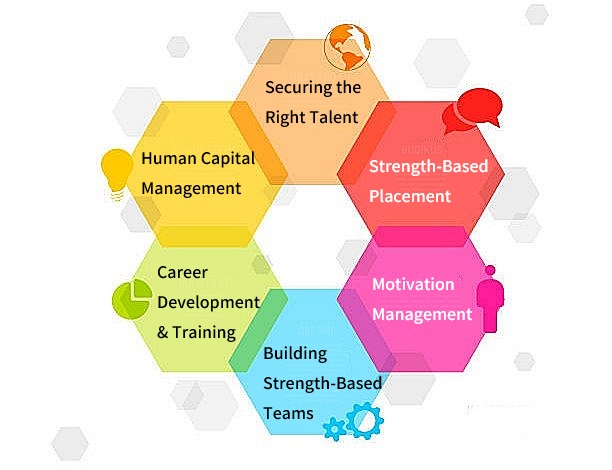
Introducing talent management allows you to maximize each employee’s capabilities while building a system that sustains growth and innovation even in rapidly changing environments.
Organizational productivity and cohesion increase, holding great potential to dramatically enhance competitiveness.
Let’s organize the key effects below.
- Promotes Employee Growth and Boosts Motivation Talent management places emphasis on carefully understanding each employee’s strengths, values, and other characteristics and assigning work and roles that fit.
When people can leverage their areas of strength, they are more likely to act proactively rather than feeling they are being forced.
As individual growth aligns with organizational goals, work motivation naturally increases, which in turn raises employee engagement.
- Activates Innovation By understanding diverse personalities and specialized skills through talent management, you can more easily form optimally composed teams.
For example, assembling members with achievements in different fields makes it easier to incorporate new ideas and perspectives, creating conditions where unexpected synergies emerge.
When such team formation becomes routine, an innovation mindset takes root organization-wide, broadening the potential for spontaneous new projects and innovative ideas even in turbulent environments.
- Reduces Management Risk Companies always face the risk that key projects stall due to sudden resignations or transfers of key personnel.
Talent management regularly visualizes employees’ skills and career orientations and continuously develops and places future successors and highly specialized talent.
This prevents over-concentration of work on specific individuals and makes it easier to secure management stability and continuity.
- Strengthens Organizational Competitiveness In the VUCA era, business environments change daily and past common sense or success stories often no longer apply.
To cope, companies must continue to utilize their human capital flexibly and strategically.
By increasing the precision of development plans and placement through talent management, organizations can more easily maintain and strengthen competitiveness over the long term.
For instance, you can build organizations that adapt to new technologies or expand globally.
Why Individual Diagnostic Assessments Matter
To introduce and operate talent management, individual diagnostic assessments—or testing—are crucial.
They are indispensable for optimally leveraging diverse talent and raising overall organizational performance.
The main reasons are as follows.
- Objectively Identify Each Employee’s Strengths and Characteristics
- Reduce Mismatches in Placement and Development
- Enable Individually Optimized Career Development
- Smooth Organizational Communication
When diagnostic assessments help people understand their own and others’ thinking patterns and behavioral tendencies, differences are more readily accepted. In reality, team troubles and communication gaps often stem from misreading others’ personalities and behavioral tendencies. Sharing assessment results deepens mutual understanding and promotes smoother communication.
- Reduce Management Risk and Support Long-Term Growth
Diagnostic assessments objectively measure personality and Behavioral Traits.
Rather than relying solely on impressions from managers or colleagues, you can understand each person’s areas of strength and working style based on scientific and statistical evidence.
With this objective data, decisions on placement and career development become easier.
When people-job mismatches occur, what happens? Often, motivation declines, resignations increase, and organizational productivity drops.
By leveraging data from diagnostic assessments, you can consider roles and positions that fit each person’s personality, orientation, and skill set,
which ultimately reduces turnover and enhances company-wide productivity.
Clarifying strengths and challenges makes it easier to design development programs tailored to each individual.
For example, provide leadership-focused training for potential leaders. Such individualized support raises the person’s own motivation to grow and helps the organization develop human capital in a planned way.
To mitigate risks such as sudden resignations of key people, you need systems where multiple members can assume critical roles.
Using assessments to grasp each employee’s strengths and potential makes it easier to develop successors organizationally and to identify leader candidates and experts early.
Such initiatives support the organization’s sustainable growth.
Diagnostic assessments are effective tools for objectively understanding each employee’s strengths and characteristics and applying them to placement, development, and team building. By discerning the fit between people and work, they raise organizational productivity and employee motivation, making them increasingly important for companies. To respond swiftly to change and sustain long-term growth, leveraging aptitude assessments is essential.
Current Types, Features, and Challenges of Diagnostic Assessments
There are various types of diagnostic assessments, each with features and challenges.
Personality tests, cognitive ability tests, competency evaluations, 360-degree reviews, and comprehensive web-based assessments using AI should be selected to match the company’s purpose, size, and culture.
Any test result should be regarded as “one part of the data,” and by establishing ways to use it and feedback systems, you can promote employee growth and improve organizational performance.
With proper introduction and operation, these systems benefit both people and organizations.
Below is a summary of the main types commonly used in companies, their features, and current challenges.
1. Personality Tests
■ Features: Big Five, MBTI, and DISC are representative methods. They measure personality tendencies and Behavioral Traits multi-dimensionally and are often used for team building, placement, and individual career development.
Many can be completed in a short time and are relatively easy to introduce.
■ Challenges: Variation in measurement accuracy and reliability
Results can vary significantly depending on wording and the respondent’s attitude.
It is necessary to confirm whether the test has a sound psychological foundation.
■ Interpretation easily becomes subjective: How results are used depends on the practitioner’s understanding, so expert advice and appropriate feedback systems are important.
2. Aptitude (Ability) Tests
■ Features: Cognitive ability tests (verbal, numerical, logical, etc.) and general knowledge tests fall into this category.
Online testing systems are widespread, making it easy to increase the number of test-takers and frequency.
They readily capture the basic abilities needed to perform work, so they are often used in new graduate or generalist hiring.
■ Challenges: Aptitude tests alone cannot capture the whole of human ability. Abilities that are hard to quantify—such as Creativity or Communication Ability—are difficult to measure, making comprehensive evaluation challenging.
■ Potential disadvantage for some candidates: Age, cultural background, and learning environment may advantage or disadvantage certain groups.
Fair evaluation requires combining multiple methods.
3. Competency Evaluation (Behavioral-Trait Evaluation)
■ Features: These assessments visualize the “behavioral traits that drive results” (competencies) set by each organization or job type.
Respondents answer concrete behavioral cases and items to evaluate the extent to which they possess those traits.
They are easy to customize to organizational culture and job roles and are relatively closely tied to practical work.
■ Challenges: Time- and cost-intensive to design and implement. Organizing company-specific behavioral traits and setting evaluation criteria is complex, and post-introduction operation also takes effort.
Maintaining objectivity requires expertise: Without expert oversight and statistical backing, criteria can become arbitrary.
■ Regular updates are essential: As business strategies and markets change, required behavioral traits change, so continuous updates are needed.
4. 360-Degree Evaluation (Multi-Rater Review)
■ Features: Gathers evaluations not only from supervisors but also colleagues, direct reports, customers, and other stakeholders.
It captures behaviors and skills from multiple angles, helping bridge gaps with self-evaluations and identify improvement points.
It can activate organizational communication and promote mutual understanding.
■ Challenges: Bias and interpersonal dynamics can affect ratings. Relationships among raters and personal likes/dislikes can distort accuracy.
■ Follow-up is indispensable: Simply handing back feedback can leave next steps vague.
Without goal-setting and coaching after feedback, it tends to become a formality.
5. Comprehensive Web-Based Assessments (Including AI)
■ Features: Increasingly, personality tests, cognitive ability tests, video interviews, and AI-based behavioral analysis are integrated.
AI analyzes large volumes of test data to evaluate skills, orientations, and behavioral tendencies comprehensively.
Strengths include speed and scalability, with the convenience of online implementation.
■ Challenges: Data reliability and algorithm transparency—AI processes can become black boxes, making it hard for candidates and companies to accept results.
■ Personal information and privacy: Handling multifaceted data requires robust security and clear data-handling rules.
■ Introduction costs and expert staffing: To maximize new technologies such as AI, organizations need to hire or train people with the right expertise.
Overall Challenges and Future Outlook
- Lack of skills to interpret and apply results: Test results are just information; the key is connecting them to placement, development, and evaluation. Appropriate feedback and HR measures are essential.
- Introduction costs and ongoing operational effort: Tools and systems require investment; regular updates and validation demand organizational readiness.
- Proliferation of diverse tools and difficulty standardizing: With many tools on the market and differing organizational purposes and methods, lack of standardization makes comparisons time-consuming.
- Burdens on individuals and psychological barriers: Frequent multi-faceted assessments can create pressure or resistance for test-takers.
- It is vital to explain appropriate frequency and the benefits of taking assessments.
Support for Introducing and Building Talent Management
Our “Talent Management Introduction & Building Support” consulting leverages extensive experience introducing talent management and approaches implementation with a holistic view that integrates management and HR perspectives. By applying psychological statistics, we can enhance data accuracy and reliability.
“Rediscover people and organizations with data and psychology. Build talent management for the next future.”