Psychological Safety
We aim to build an environment where everyone can freely express opinions and ideas and feel safe to take on challenges.
Organizations are expected to grow with the times.
To build organizations that adapt to change, we must first understand organizational growth models and raise the level of psychological safety toward an organizational model suited to a new era. However, sudden large-scale transformation can exhaust teams and fuel dissatisfaction. It is therefore vital to move toward the ideal organization step by step. First, thoroughly understand the organizational growth model. Next, shape an environment that enables free and active exchange of views. Finally, focus on securing psychological safety. Both “open exchange of opinions” and “psychological safety” are essential for healthy and effective team operations. Psychological safety prioritizes a “safe environment for taking risks,” while open exchange fosters “free and lively communication.” Balancing both elements builds trust and enables highly creative, innovative teams. For those interested in organizations and HR, building organizations that fit the times is increasingly important. Through a phased approach, we will pursue sustainable, resilient organizations.
“Open exchange of opinions” means:
- Active interaction: Ideas and opinions flow freely, encouraging creative thinking.
- Flexibility: Unconstrained by formality; flexible thinking and behavior are encouraged.
- Sociability: Active interaction among members fosters warm relationships.
Psychological safety means:
- A sense of security: Confidence that expressing opinions will not invite denial or punishment.
- Trust: Treating failures as learning opportunities rather than blaming individuals.
- Healthy communication: A culture where questions, concerns, consultations, and proposals can be shared freely.
Steps to Secure Psychological Safety
- Understand organizational growth models: Organizations grow. We especially use Tuckman’s four stages, which overlap with life-cycle and Greiner models. Forming ➡ Storming ➡ Norming ➡ Performing ➡ Adjourning.
- Create an environment for open exchange: In the Forming stage, leaders share purpose, reason for being, and vision. Establish ground rules. Define and present common language as an essential tool.
- Design spaces for open exchange: To embrace and value diversity, actively introduce “Exchange Chair” dialogues so teams can experience that “pro vs. con” are still one team.
- Secure psychological safety: Storming varies in degree but is usually experienced. With proper handling in Forming, it can be weathered smoothly. Focus on the following at this stage.
Key Initiatives to Realize Psychological Safety
- Clarify leadership roles: Leaders model openness and receptivity to feedback. This makes it easier for members to speak up.
- Promote open communication: Do not cut people off; listen carefully so members feel respected. Provide regular opportunities for feedback and constructive exchanges.
- Create a culture that treats failure as learning: Share failures, analyze causes, and avoid repetition. Emphasize that real failure is “failing to learn,” and encourage people to apply what they learned next time.
- Respect diversity and inclusion: Normalize having members with different perspectives and backgrounds and actively incorporate diversity. Teams that practice “Exchange Chair” recognize unconscious bias and learn to shift perspectives.
- Set clear roles and expectations: Reconfirm organizational and team purpose and vision, and ensure everyone understands them again. Also clarify each member’s role and responsibilities to create a secure work environment..
- Provide education and training on psychological safety: Hold team workshops that cover the “why” (importance) and the “how” (practical methods). How to actually communicate matters.
- Conduct regular assessments and feedback: Monitor how members perceive psychological safety and grasp the current state. Based on this, plan and implement concrete improvements and continuously enhance the environment.
- Institutionalize an environment that accepts diversity: In routine meetings and exchanges, ensure everyone has opportunities to speak. Build a setting where members can seek help whenever they face difficulties.
Five Effects and Benefits Psychological Safety Brings to Teams
With psychological safety in place, the factors for team success are met, and organization-wide benefits also follow:
- Higher employee satisfaction and lower turnover.
- Greater Engagement with teams and the organization accelerates referral hiring (an effective method leveraging employees’ networks).
- Active exchange of ideas and opinions boosts performance.
- Improved cross-functional collaboration makes work and processes smoother.
- A stronger sense of unity drives proactive commitment to solving organizational issues.
Thus, it benefits both company and teams, making work easier for members and improving productivity. Psychological safety brings positive effects for both the company and its employees.
The True Purpose of Pursuing Psychological Safety
The purpose of introducing psychological safety is to achieve high team productivity. Psychological safety is a means. In the short term it may be a goal, but the purpose is team productivity—and ultimately even this may be a means. The ultimate purpose may be sustained economic growth of the company and business. Here we focus on the “true purpose.” The true purpose is to provide an environment where members feel safe to express themselves, leading to activated communication, innovation, improved team performance, growth for individuals and the organization, strengthened Engagement, and more. Through this, sustainable growth and success of the entire organization and business are achieved.
Establishing psychological safety is not just about a nicer atmosphere; it is a key factor that strengthens competitiveness. Leadership and ongoing effort are indispensable, and those efforts contribute to organizational development. In this VUCA era, doing X does not guarantee success, nor does past experience always apply. Sometimes past success can hinder future success.
In this context, a common challenge for developing companies and businesses is to become more “creative & innovative.” In particular, it is said that there are only three types of people who can drive transformation: “the young,” “outsiders,” and “mavericks.” The young refers to the current Gen Z workforce. Outsiders are mid-career hires or internal transferees. Mavericks are not truly foolish; they are people whose values differ greatly—those who hold perspectives different from the mainstream. Leaders may not single-handedly create transformation, but they can lead and support it. Leadership is therefore crucial—to bring these people together and make change happen.
Uniting such people to drive change—and intentionally appointing diverse talent to spark entirely new thinking and heighten creativity—is a common imperative for advancing companies and businesses. We live in a time when denying or rejecting diversity is no longer an option. Many leaders have never faced such external changes. Quick decisions are essential so as not to fall behind this movement.
The Importance of Soft Approaches
Organizations are groups of people, and people are chosen to realize specific purposes and values. To achieve those purposes, effective teams must be formed through appropriate hiring, appointment, rotation, and promotion. Concretely, it is essential to understand how each member’s individual characteristics are utilized—across personality, thinking, behavior, and more.
The Team Leader’s Role
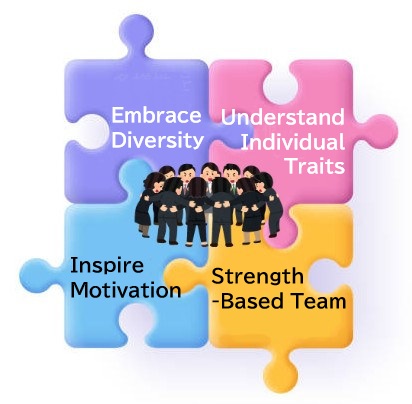
For team leaders in particular, understanding and grasping members’ characteristics is essential.
Without trust and relationships, no strong team can be formed.
First, adopt an attitude that embraces and leverages diversity. Next, understand each member’s individual characteristics and assign appropriate roles.
Furthermore, leaders need approaches that maximize team power by leveraging strengths and boost Motivation.
Human relationships—such as “I want to work under that boss” or “I want to work in an open team”—are critically important.
Even difficult work environments can become heavenly—or hellish—depending on team relationships.
Demonstrating Leadership Ability as a team leader is extremely important.
Summary
Introducing psychological safety creates a setting where team members can share opinions and ideas freely and securely. In such an environment, creativity and innovation increase, problem-solving improves, and team performance rises. Strengthened trust deepens collaboration, and organization-wide Engagement improves. Psychological safety is realized through open communication and supportive structures and becomes a vital foundation that sustains growth and success. By building a workplace where people can take on challenges with confidence, organizations move toward a stronger, more flexible future.
Consulting to Secure Psychological Safety with Certainty
Our consulting leverages the 5D Profile Diagnosis to realize a safe environment where team members can exchange opinions freely, making psychological safety more reliably achievable by clarifying each member’s traits and relationships and laying the foundation for optimal team building. We help create a culture where open exchange is the norm and people are unafraid of new, difficult challenges, thereby boosting organization-wide performance.
“We support building safe environments that enable free thinking.”